Luteal Phase Support with Estradiol in Poor Responders Undergoing in vitro Fertilization/Intra-Cytoplasmic Sperm Injection Using Gonadotropin Releasing Hormone Antagonist Protocol: A Double Blind Randomized Controlled Trial
Mostafa Foaad Gomaa1, Sara Osama Mohamed2*, Gasser Mohamed Adly Elbishry3 and Radwa Rasheedy Ali4
1,3,4Obstetrics & Gynecology department, Faculty of medicine, Ain Shams University, Cairo, Egypt
4Obstetrics & Gynecology department, Faculty of medicine, KS University, Kafr el Sheikh, Egypt
*Address for Correspondence: Sara Osama Mohamed, Ain Shams university, Cairo, Egypt, Tel: +201-021-004-415, ORCiD: https://orcid.org/0000-0003-0350-9374; E-mail: [email protected]
Submitted: 18 February 2020; Approved: 25 February 2020; Published: 28 February 2020
Citation this article: Gomaa MF, Mohamed SO, Adly Elbishry GM, Ali RR. Luteal Phase Support with Estradiol in Poor Responders Undergoing in vitro Fertilization/Intra-Cytoplasmic Sperm Injection Using Gonadotropin Releasing Hormone Antagonist Protocol: A Double Blind Randomized Controlled Trial. Int J Reprod Med Gynecol. 2020;6(1): 001-015.
Copyright: © 2020 Gomaa MF, et al. This is an open access article distributed under the Creative Commons Attribution License, which permits unrestricted use, distribution, and reproduction in any medium, provided the original work is properly cited
Keywords: Estradiol (E2) supplementation; Gonadotropin Releasing Hormone (GnRH) antagonist; Poor responder women; in vitro Fertilization (IVF); Live birth rate; Clinical pregnancy
Download Fulltext PDF
Background: The role of Progesterone (P) supplementation in the luteal phase of in vitro Fertilization (IVF) cycles is actually well known, but the role of Estradiol (E2) level during the luteal phase is not obvious. However, there is a significant difference in estradiol levels between fertile women who underwent in vitro Fertilization (IVF).
Purpose: To find if estradiol addition in the luteal phase has a role in women with poor ovarian response who undergoing in vitro Fertilization.
Methods: In a prospective randomized clinical trial, 170 poor responder women were randomly divided by (computerized software) into two groups; the control group (85 patients) received only vaginal progesterone, and the intervention group (85 patients) received progesterone, and estradiol valerate (4 mg/d). Live birth, biochemical pregnancy and clinical pregnancy rates were documented for those who completed the study protocol in each group (per protocol analysis), and compared between the groups.
Results: Seventy four patients in control group and seventy six patients in Intervention group successfully completed the study protocol. Treatment outcomes were significantly different between two groups that estradiol support, compared with progesterone only, showed higher rate of chemical pregnancy (RR = 2.40, 95% CI = 1.42 to 4.05, p = 0.001, NNT = 4.0, ARR = 24.8% ,RRR = 58.5%), clinical pregnancy (RR = 2.39, 95% CI = 1.34 to 4023, p = 0.002, NNT = 5.0, ARR = 21.2%, RRR = 58%), and live birth (RR = 2.6, 95% CI = 1.34 to 5.05, p = 0.003, NNT = 5.0, ARR = 18.8%, RRR = 61%).
Conclusion: For women with poor ovarian response who underwent IVF using Gonadotropin Releasing Hormone (GnRH) antagonist protocol, the addition of 4 mg E2 to P4 in the luteal phase could significantly improve the pregnancy outcomes.
Abbreviations
AFC: Antral Follicle Count; AMH: Anti-Mullerian Hormone; ARR: Absolute Risk Reduction; ART: Assisted Reproductive Techniques; ASU: Ain Shams University; BMI: Body Mass Index; CI: Confidence Interval; CL: Corpus Luteum; COS/COH: Controlled Ovarian Stimulation/Hyper-Stimulation; CRF: Case Record Data Form; E2: Estradiol; ERC: Ethics Research Committee; ESHRE: European Society for Human Reproduction and Embryology; FSH: Follicle Stimulating Hormone; GA: Gestational Age; GDM: Gestational Diabetes Mellitus; GN: Gonadotropin; GnRH: Gonadotropin Releasing Hormone; HCG: Human Chorionic Gonadotropin; i.m: Intramuscular; ICSI: Intra-Cytoplasmic Sperm Injection; ITT: Intention to Treat; IU: international unit; IVF: in vitro Fertilization; KSU: Kafr el Sheikh University; NNT: Number Needed to Treat; OP: Ovum Pick Up; P4: Progesterone; POR: Poor Ovarian Response; PROM: Preterm Rupture of Membranes; PTL: Preterm Labor; p-value: Probability Value, RCT: Randomized Controlled Trial; RR: Relative Risk; RRR: Relative Risk Reduction; SD: Standard Deviation.
Introduction
Assisted Reproductive Technology (ART) use is increasing to assist couples to have a family with live birth rate reaching 30% [1]. In poor responder women, the decrease in the number of eggs is still the problem in improving the live birth rates [2]. According to European Society for Human Reproduction and Embryology (ESHRE), Poor Ovarian Response (POR) is specified with at least two of the following three criteria; advanced age of mother or other risk factor causing POR, for example, a previous poor ovarian response with development of 3 oocytes or fewer in the former cycle by Controlled Ovarian Stimulation (COS) protocol and any abnormality in ovarian reserve tests [3].
During embryo implantation, the uterus transforms into a ‘receptive’ state so that the blastocyst can form a close physical and physiological contact with the endometrium. Factors needed for the receptivity of the endometrium are Estradiol (E2) and/or Progesterone (P4) that act by their respective receptors [4].
Nowadays, a lot of IVF cycles involve conduction of Gonadotropin Releasing Hormone (GnRH) agonists or antagonists, so there is disruption of the pulsating manner needed for P4 production causing luteal phase dysfunction [5]. The corpus luteum secretes P4, E2 and other steroid hormones, but authors still questioned if the adding E2 to P4 could improve pregnancy outcomes [6].
Luteal phase estradiol stimulates progesterone receptors and also proliferate endometrial gland resulting in hypertrophy and hyperplasia of endometrial epithelium that may help in the implantation [3].
A 2011 Cochrane review evaluated seven studies that revealed that the adding E2 to P4 could improve the clinical pregnancy rate, but not affect ongoing pregnancy, fertilization, implantation rates. However, prior meta-analyses, such as those by Kolibianakis and Gelbaya and colleagues, found no profitable effect of this combination on the pregnancy rates [7].
Material and Methods
In this randomized clinical trial between April 2018 and September 2019 (Clinical trial identifier: NCT03788681), all consecutive patients who presented for the purpose of ART at the assisted reproduction unit at Ain-shams University, the maternity hospital and a private IVF center were enrolled the study. Among these patients, those who fitted inclusion criteria were selected for the treatment protocol and those with any of exclusion criteria were taken apart. These inclusion criteria are (participants should have two of three criteria):
1) Advanced age of the mother or another risk factor causing POR; age ≥ 35 years, and the other risk factors; ovarian surgery, chronic smoking, unexplained Infertility, autoimmune disorders and single ovary.
2) Former POR: number of oocytes at the pickup time 3 or less.
3) Abnormal ovarian reserve tests: In the early follicular phase, FSH ≥ 12 mIu/ml and E2 ≥ 70 pg/dl. Anti-Mullerian Hormone (AMH) ≤ 0.5-1.1 ng/ml, and the Antral Follicle Count (AFC) < 5-7 follicles.
On the other side, the exclusion criteria are ; age >35 with good response to COS, any intra-uterine lesion can affect receptivity such as sub-mucosal fibroid or intra-uterine adhesions ,severe male factor infertility, extended endometriosis and contraindications for the use of estradiol : stroke, breast cancer and thrombo-embolism.
Ethics approval and informed consent
The study protocol was approved by Ethics Research Committee (ERC), Faculty of Medicine, Ain Shams University (ASU), with presentation of patient’s information leaflet, consent form, and Case Record Data Form (CRF). The clinical trial identifier is (NCT03788681). Each patient took informed consent before enrollment in the study. Those without an informed consent were excluded from the study. These patients, included in the study, were randomized in two groups (intervention or control) using computerized software.
Study intervention: All women were subjected to proper history taking, examination and investigations to ensure fitting the definition of poor responder to ovarian stimulation. Trans-vaginal ultrasonography by the same experienced gynecological sonographer to exclude any uterine or pelvic lesions.
Controlled Ovarian Hyper-Stimulation (COH)
Study participants used GnRH antagonist protocol starting on cycle day 3, using recombinant FSH; follitropin alfa, 5.5 micrograms, (Gonal-f®, 75 IU, Merck-Serono, Darmstadt, Germany), intra-muscular injection of 300 IU/day after establishing ovarian and uterine quiescence using vaginal ultrasound. The r-FSH doses given according to the ovarian response, monitored by trans-vaginal ultrasound and serum E2 levels every two-four days. GnRH antagonist; Cetrorelix acetate, (Cetrotide®, 0.25 mg, Serono, Darmstadt, Germany) was given by sub-cutaneous injection from the sixth day of the cycle and continued daily until the day of administration of Human Chorionic Gonadotropin (HCG). Highly purified urinary HCG, (Choriomon®, Lyophilized human chorionic gonadotropin, 5000 IU, IBSA, Lugano, Switzerland), 10000 IU were injected leading to maturation of the follicles ( > 3 follicles of > 18 mm seen on the scan).
Serum estrogen and progesterone were measured on the day of HCG injection. Trans-vaginal pick up of the oocytes was done under general anesthesia within 36-38 hours after HCG injection.
Luteal Phase Support (LPS )
Within 24 hours of oocyte retrieval, the patients will receive either:
Group 1 (Progesterone/placebo group): Luteal phase support with vaginal progesterone (Prontogest®, progesterone, 400 mg, Marcyrl, Cairo, Egypt) once daily was started within 24 hours of Ovum Pickup (OP) till 12th week of gestation if pregnancy was achieved. With addition of two tablets of a placebo, which is an oral tablet in the same form and shape of estradiol tablet, started within 24 hours of OP and used till the 7th week of gestation if pregnancy occurred.
Group 2 (Progesterone/E2 group): The same treatment as in the previous group but with addition of oral estradiol, estradiol valerate, (Cyclo-Progynova®, 2 mg, Bayer Schering Pharma Ag, Leverkusen, Germany) taken twice daily within 24 hours of OP till the 7th week of gestation (the time for a scan to confirm fetal heart viability) if pregnancy occurred. Serum b-HCG was measured 16 days after HCG injection.
Finally, two to three embryos were transferred using the ultrasound imaging on day 3 after oocyte pick up and ICSI.
Outcomes
The primary outcome was live birth rate, which means the number of deliveries (more than 28 weeks gestational age) that resulted in a live neonate, expressed per 100 embryo transfers. Secondary outcomes were biochemical pregnancy per embryo transfer and clinical pregnancy rate.
Statistical Analysis
Data were analyzed using IBM© SPSS© Statistics version 23 (IBM© Corp, Armonk, NY).
Continuous numerical variables were presented as mean and SD and inter-group differences were compared using the unpaired t-test.
Categorical variables were presented as number and percentage and differences were compared using the Pearson chi-squared test or Fisher’s exact test as appropriate. Ordinal data were compared using the chi-squared test for trend.
p < 0.05 are considered statistically significant.
Results
Out of 185 patients eligible for recruitment to the study, 170 were enrolled to undergo ICSI and be randomized within 24 hours of ovum pick-up to receive one of two different modes of luteal support. Nine patients in both groups had their cycles cancelled. A further 11 patients were lost during follow up leaving 150 patients who completed the study. Figure 1 shows the patients’ different flowcharts.
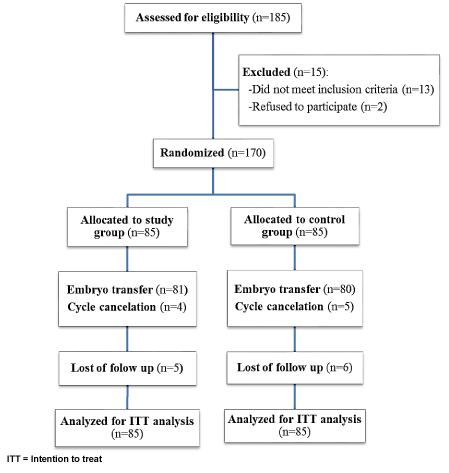
Baseline characteristics, laboratory results, and outcomes of the ovarian stimulation in each group are summarized in table 1. The main outcomes of the treatment of the protocol for each group as shown in table 2 were significantly different between both groups.
All intervention and control patients were followed-up till the primary outcome “live birth rate” was achieved. So estradiol support was associated with significantly higher rates of chemical pregnancy (RR = 2.40, 95% CI = 1.42 to 4.05, p = 0.001, NNT = 4.0, ARR = 24.8%, RRR = 58.5%), clinical pregnancy (RR = 2.39, 95% CI = 1.34 to 4023, p = 0.002, NNT = 5.0, ARR = 21.2%, RRR = 58%)and live birth (RR = 2.6, 95% CI = 1.34 to 5.05, p = 0.003, NNT= 5.0, ARR = 18.8%, RRR = 61%)as shown in table 3.
As regard chemical pregnancy; estradiol support (odds ratio = 3.692, 95% CI = 1.764 to 7.729, p = 0.001), and secondary type of infertility (odds ratio = 2.161, 95% CI = 1.027 to 4.548, p = 0.042) were independent determinants of chemical pregnancy that after adjustment for age, BMI, picked up oocytes, frequency of previous treatment cycles, endometrial thickness, and E2 level (Table 4).
However, estradiol support (odds ratio = 3.364, 95% CI = 1.564 to 7.236, p = 0.002) and picked up oocytes (odds ratio = 1.817, 95% CI = 1.107 to 2.983, p = 0.018) were independent determinants of clinical pregnancy (table 5). Concerning our primary outcome, live birth rate, also estradiol support (odds ratio = 3.754, 95% CI = 1.594 to 8.838, p = 0.002) and picked up oocytes (odds ratio = 2.426, 95% CI = 1.369 to 4.299, p = 0.002) were independent determinants of live birth (table 6).
Complications detected during treatment and follow up periods among the patients were not significantly different between two groups as shown in table 7.
Discussion
In this study, cases recruited for ICSI using a starting dose of recombinant FSH ranging from 150 to 375 IU, with a fixed day of embryo transfer (day 3), and a fixed estradiol dose (4 mg) to decrease any possible bias.
Patients’ ages were insignificantly different (mean = 37.2, SD = 1.7) in the study group while in the control one (mean = 37.1, SD = 1.9), also their body mass index were insignificantly different; in the study group (mean = 30.1, SD = 3.1), and in the control group (mean = 30.4, SD = 3.4) (table 1).
Patients’ characteristics, type of infertility, ovarian stimulation outcomes, and hormonal levels were comparable but the difference not statistically significant in both groups except the number of picked up oocytes was significantly different; (mean = 2.4, SD = 0.8 ) in the study group while in the control one (mean = 2.1, SD = 0.8), p = 0.041 (Table 1).
Pregnancy outcomes were significantly different between both groups as chemical pregnancy rate was 42.4%, clinical pregnancy rate was 36.5%, and live birth rate was 30.6% in the study group, while in the control group were 17.6 %, 15.3%, and 11.8% respectively as shown in table 2.
Estradiol support was associated with significantly showed higher rate of chemical pregnancy (RR = 2.40, 95% CI = 1.42 to 4.05, p = 0.001, NNT = 4.0, ARR = 24.8%, RRR = 58.5%), clinical pregnancy (RR = 2.39, 95% CI = 1.34 to 4023, p = 0.002, NNT = 5.0, ARR = 21.2%, RRR = 58%), and live birth (RR = 2.6, 95% CI = 1.34 to 5.05, p = 0.003, NNT = 5.0, ARR = 18.8%, RRR = 61%) as shown in table 3.
After adjustment for age, BMI, picked up oocytes, frequency of previous treatment cycles, endometrial thickness, and E2 level; estradiol support (odds ratio = 3.692, 95% CI = 1.764 to 7.729, p = 0.001) and secondary type of infertility (odds ratio = 2.161, 95% CI = 1.027 to 4.548, p = 0.042) were independent determinants of chemical pregnancy (table 4).
In clinical pregnancy; estradiol support (odds ratio = 3.364, 95% CI =1.564 to 7.236, p = 0.002), and the number of picked up oocytes (odds ratio = 1.817, 95% CI = 1.107 to 2.983, p = 0.018) were the independent determinants (table 5).
Estradiol support (odds ratio = 3.754, 95% CI = 1.594 to 8.838, p = 0.002) and the number of picked up oocytes (odds ratio = 2.426, 95% CI = 1.369 to4.299, p = 0.002) were also independent determinants of live birth as shown in table 6.
As regard pregnancy complications; miscarriage, gestational hypertension, Gestational Diabetes Mellitus (GDM), Premature Rupture of Membranes (PROM), preterm labor, and Intrauterine Fetal Death (IUFD) were comparable in both groups but the difference was not statistically significant table 7.
In the same way of our study, Kwon, et al. [8] presented a prospective study, which revealed that the addition of E2 to P4 for luteal support in cycles, using GnRH antagonist protocol, improved significantly embryo implantation rate (2.0% vs. 15.8%, p = 0.035) in infertile patients who underwent IVF, and also improvement in pregnancy outcomes. Furthermore, this combination significantly reduced the incidence of vaginal bleeding in the luteal phase (7.4% vs. 27.8%, p = 0.010).
A research meta-analysis performed by Zhang, et al. [7] published in 2015, was on the usage of progesterone alone, or with adding any forms of estradiol in the luteal phase during IVF. Results of statistical analysis indicated that progesterone combined with estradiol resulted in improvement of pregnancy outcomes (pooled odds ratio 1.617, 95% confidence interval 1.059 - 2.471; p = 0.026).
On the other hand, Madkour, et al. [9] study was prospective, and randomized, 220 patients were included, using the GnRH antagonist protocol for COS. There was no significant difference between group (A) which received vaginal progesterone and group (B) which received 4 mg of estradiol plus the vaginal progesterone. It was found that pregnancy rates showed no significant difference between group A (39.09%), and B (43.63%) (p = 0.3). Ongoing pregnancy rates also showed no significant difference between two groups (p = 0.1).
However, a Cochrane Database Systematic Review carried out by Van der Linden, et al. [1] reported that synthetic progesterone favored over micronized progesterone, while the addition of estrogen did not improve outcomes.
It is interesting that studies used long agonist protocol gave conflicting results; some were with the combination between E2, and P4, for example, Farhi, et al. [10] used 4mg estradiol/day, while Ghanem, et al. [11] and Lukaszuk, et al. [12] used 6 mg/day. Other studies were against, such as studies by Smitz, et al. [13] and Serna, et al. [14] which used different estradiol doses but did not improve pregnancy outcomes.
There was a debate about using estradiol with progesterone as a luteal phase support in POR undergoing IVF; some studies prompted this combination, while others are against. Our study demonstrated that this combination showed higher chemical, clinical pregnancy, and live birth rates.
Conclusion
Our study revealed that poor responders using 4 mg/day estradiol with progesterone in the luteal phase significantly ameliorated the pregnancy outcomes concerning chemical, clinical pregnancy, and live birth rates.
Acknowledgments
The authors would like to thank all the participants, medical staff and co-workers who cooperated in this study for their precious support.
- Linden M, Buckingham K, Farquhar C, Kremer J, Metwally M. Luteal phase support for assisted reproduction cycles. Cochrane Database Syst Rev. 2011; 10: 9154. PubMed: https://www.ncbi.nlm.nih.gov/pubmed/21975790
- Ubaldi F, Vaiarelli A, D Anna R, Rienzi L. Management of poor responders in IVF: Is there anything new. Bio Med Res Int. 2014; 352098. http://bit.ly/32sG92a
- Rehman R, Tariq S, Tariq S, Hashmi F, Baig M. Mid-luteal estradiol levels of poor/good responders and intra-cytoplasmic sperm injection. Pak J Med Sci. 2017; 33: 182-186. PubMed: https://www.ncbi.nlm.nih.gov/pubmed/28367196/
- Lee H, Hyun JC, Yang KM, Kim MJ, Cha SH, Yi HJ. Efficacy of luteal phase estrogen administration & an early follicular GnRH antagonist priming protocol in poor responders undergoing IVF. Obstet Gynecol Sci. 2018; 6: 102-110. PubMed: https://www.ncbi.nlm.nih.gov/pubmed/29372156/
- Yanushpolsky E. Luteal phase support in IVF. Semin reprod Med. 2015; 33: 118-127. PubMed: https://www.ncbi.nlm.nih.gov/pubmed/25734349
- Lin H, Li L, Wang W, Zhang Q, Cheu X, Yang D. Oral estradiol supplementation as luteal phase support in IVF/ICSI cycles: a prospective randomized controlled trial. Eur J Obstet Gynecol Reprod Biol. 2013; 167: 171-175. PubMed: https://www.ncbi.nlm.nih.gov/pubmed/23287635
- Zhang XM, Lv F, Wang P, Huang XM, Liu KF, Pan Y, et al. Estradiol supplementation to progesterone as luteal phase support in patients undergoing IVF. Medicine. 2015; 94: 459. PubMed: https://www.ncbi.nlm.nih.gov/pubmed/25715250
- Kwon SK, Kim CH, Lee KH, Jeon IK, Ahn JW, Kim S, et al. Luteal estradiol supplementation in gonadotropin-releasing hormone antagonist cycles for infertile patients in vitro fertilization. Clin Exp Reprod Med. 2013; 40: 131-134. PubMed: https://www.ncbi.nlm.nih.gov/pubmed/24179871/
- Madkour W A, Noah B, Abdel Hamid AM, Zaheer H, Al Bahr A, Shaeer M, et al. Luteal phase support with estradiol and progesterone versus progesterone alone in GnRH antagonist ICSI cycles: a randomized controlled study. Hum Fertil (Camb). 2016; 19: 142-149. PubMed: https://www.ncbi.nlm.nih.gov/pubmed/27434094
- Farhi J, Weissman A, Steinfel Z, Shorer M, Nahum H, Levran D . Estradiol supplementation during the luteal phase may improve the pregnancy rate in patients undergoing in vitro fertilization-embryo transfer cycles. Fertil Steril. 2000; 73: 761-766. PubMed: https://www.ncbi.nlm.nih.gov/pubmed/10731538
- Ghanem ME, Sadek EE, Elboghdady LA, Helal AS, Gamal A, Eldiasty A. The effect of luteal phase support protocol on cycle outcome and luteal phase hormone profile in long agonist protocol intracytoplasmic sperm injection cycles: A randomized clinical trial. Fertil Steril. 2009; 92: 486-493. PubMed: https://www.ncbi.nlm.nih.gov/pubmed/19464001
- Lukaszuk K, Liss J, Lukaszuk M, and Maj B. Optimization of estradiol supplementation during the luteal phase improves the pregnancy rate in women undergoing in vitro fertilization-embryo transfer cycles. Fertil Steril. 2005; 83: 1372-1376. PubMed: https://www.ncbi.nlm.nih.gov/pubmed/15866571
- Smitz J, Bourgain C, Van Waesberghe L, Camus M, Devroey P, Van Steirteghem AC. A prospective randomized study on estradiol valerate supplementation in addition to intra-vaginal micronized progesterone in buserelin and HMG induced superovulation. Hum Reprod. 1993; 8: 40-45. PubMed: https://www.ncbi.nlm.nih.gov/pubmed/8458924
- Serna J, Cholquevique JL, Villasante A, Oriol B, Requena A, Velasco J. Adding estradiol patches to the luteal phase of IVF/ICSI cycles did not improve pregnancy nor miscarriage rates. Fertility and Sterility. 2006; 86: 73. http://bit.ly/2SZd0bR
Sign up for Article Alerts