Sleep Habits and Sleep Time Among Secondary School Students in the Province of Seville
Paolo Porcacchia1*, Georgina Botebol1, Maria Estefania Monge Marquez1, Irene Gonzalez-Moya Navarro2 and Juan Manuel Praena Fernandez2
1Servicio de Neurologia y Neurofisiologia. Hospital Universitario Virgen del Rocio. Seville. Spain
2Unidad de Estadistica, Metodologia y Evaluacion de Investigacion. Hospital Universitario Virgen del Rocio. Seville. Spain
*Address for Correspondence: Paolo Porcacchia, Servicio de Neurologia y Neurofisiologia Clinica, Hospital Universitario Virgen del Rocío. Av. Manuel Siurot s/n. 41013, Sevilla, Spain. Fax: +34 95-501-2597; Tel: +34 9-550-12484; E-mail: [email protected]
Submitted: 01 April 2020; Approved: 01 June 2020; Published: 02 June 2020
Citation this article: Porcacchia P, Botebol G, Monge Marquez ME, Moya Navarro IG, Praena Fernandez JM. Sleep Habits and Sleep Time Among Secondary School Students in the Province of Seville. Int J Sleep Disord. 2020;3(1): 001-006.
Copyright: © 2020 Porcacchia P, et al. This is an open access article distributed under the Creative Commons Attribution License, which permits unrestricted use, distribution, and reproduction in any medium, provided the original work is properly cited
Keywords: Circadian rhythm; Normal sleep-adolescents; Seep time
Download Fulltext PDF
Insufficient sleep during the adolescence can have negative consequences in terms of physical, psychological and cognitive performance and social and cultural factors are strictly associated with sleep habits.
In this study we aimed to study sleep time and sleep related habits, in a representative sample of secondary school teenagers, in the province of Seville (Spain).
Questionnaires were collected from 1074 students (53 % were women) aged 13 to 19 years old. Total sleep time during school days and no school days was calculated and other variables were obtained, as bedtime and wake up, dinnertime, the use of technological devices or social networks during the night.
Night sleep time was 7 hours 48 minutes during school days and 9 hours 29 minutes during non-school days, while total sleep time (night sleep time plus nap) was 8 hours 6 minutes during school days and 9 hours 41 minutes during non-school days. When age increases, sleep time drops significantly. Concurrently, when age increases, bedtime and dinnertime during school days delays, and the use of technological devices and social networks during the night augments. Nap in the afternoon augments with age and can partly compensate the relative sleep deprivation in older adolescent.
In this study we provide an evidence of a progressive decrease of sleep time during adolescence, with a deterioration of sleep habits. Time zone and social habits (dinner time) can contribute to a late bedtime. Nap in the afternoon is a possible mechanism to compensate short night sleep time in older adolescents.
Introduction
Sleep is crucial for physical and mental health and it plays an important role in many metabolic, immune and cognitive processes [1-4]. Importance of sleep is evident at any age and assumes specific characteristics during the different phases of growth. The focus of the present work is to assess sleep habits during adolescence in our environment.
Broad evidence supports the importance of sleep during adolescence. An insufficient or unstructured sleep is associated with physical and psychological disorders. In the adolescents, shorter sleep time is associated with overweigh and obesity [5-7], increased risk of cardiovascular diseases [8], diabetes [9,10], dyslipidemia [11], lower diet quality [12,13] and higher physical inactivity [14]. Sleeping few hours was associated with distressed personality [15] and sleep-deprived adolescent showed less positive affect and greater increased in anxiety [16]. Furthermore, children and adolescents with major depressive disorder have more fragmented sleep [17], and both short and long total sleep times are risk factors for suicidality among teens [18]. Socio-economic status, family disorganization and social determinants are other important factors in defining sleep habits and sleep time [19-21]. In particular prolonged video gaming and internet overuse may cause clinically significant disruption of adolescent sleep and excessive daytime sleepiness [22,23]. Mild sleep restriction impairs reaction times during working memory tasks in adolescents [24] and, when chronic sleep restriction is present, gradual sleep extension has beneficial effects on cognitive performance, in terms of visuospatial processing [25]. At the end of this short revision, it seems evident that sleep problems and sleep restriction during adolescence can have serious physiological, psychological and cognitive consequences.
Sleep duration in adolescents was studied in different countries. In Taiwan (12-16 years old) the mean sleep duration on weekdays was 7 hours 35 minutes and 9 hours 38 minutes on weekends. Weeknight sleep decreased significantly with increasing school grade [26]. In Korean adolescents (14-17 years old), sleep duration on weekdays was 5 hours 42 minutes and on weekends was 8 hours 24 minutes per day [27]. In Turkey (15-18 years old) total night sleep time was 7 hours 42 minutes on school nights and 9 hours 40 minutes on non-school nights. The same subjects reported a requirement of more than 10 hours of sleep, on average, to feel their best during the day [28]. In these studies, we can recognize a trend toward a sleep restriction among adolescents, more evident during school days. Another aspect is the progressive reduction of sleep time across the age [29-32], loosing up to one hour and half between 11 and 15 years old.
But how many hours an adolescent should sleep? It is difficult to define normal limits for sleep time because we do not have normative values. In a meta-analysis of quantitative sleep parameters [33], total sleep time differed across the studies, varying from 8 to 9 hours and half at 11 years old and from 7 to 8 hours 40 minutes at 15 years old. An extensive survey in United States [34] showed that total sleep time was 8 hours at 12-13 years old and less than 7 hours and half at 15 years old. Searching of “normative” values is important to establish sleep habits in different countries and trying to define what it can be considered as “restriction” or “excess” in a given population.
The objective of the present work is to study sleep time and sleep habits of secondary school student in the province of Seville, Spain.
Materials and Methods
Analyses were based on a representative sample of students from the province of Seville (Andalucia-Spain). The project was submitted and approved by the provincial commission of education and local ethical committee. The provincial commission of education selected five public secondary schools (12 to 17 years old students). A written survey was distributed in these schools, one for each student. Participation was anonymous and voluntary; a written informed consent was obtained from both parents and students. Confidentially was protected according to the law (“Ley Organica 15/1999 del 13 de diciembre, de Protección de Datos de Carácter Personal”). Each student filled out autonomously the survey. All the students completed the survey between the days 1st and 10th of May. The survey consists of three parts: sleep schedule during school days, sleep schedule during weekend, and sleep/routine habits. The following information was collected.
Sleep schedule during school days/during weekend
“When you have/don’t have class the following day, at what time do you usually go to bed?” with 13 (for school days) or 15 (weekend) possible answers for each question: not after 9 p.m., around 9.30 p.m., around 10 p.m., around 10.30 p.m., around 11 p.m., around 11.30 p.m., around midnight, around 12.30 a.m., around 1 a.m., around 1.30 a.m., around 2 a.m., around 2.30 a.m., 3 a.m. or later (for both school days and weekend) and around 3.30 a.m., 4 a.m. or later (for the weekend).
“When you have/don’t have class the following day, at what time do you usually wake up?” with 13 (for school days) or 17 (weekend) possible answers for each question: not after 6 a.m., around 6.30 a.m., around 7 a.m., around 7.30 a.m., around 8 a.m., around 8.30 a.m., around 9 a.m., around 9.30 a.m., around 10 a.m., around 10.30 a.m., around 11 a.m., around 11.30 a.m., noon or after noon (for both school days and weekend) and around 0.30 p.m., around 1 p.m., around 1.30 p.m., 2 p.m. or later (for the weekend).
“When you have/don’t have class the following day, do you take a nap in the afternoon?” with 7 (for school days and weekend) possible answers for each question: no; yes, not more than half an hour; yes, during approximately 1 hour; yes, during approximately 1 hour and half; yes, during approximately 2 hours; yes, during approximately 2 hours and half; yes, during approximately 3 hours or more.
Sleep/routine habits
“In the last six months did you have problems to fall asleep?” with 4 possible answers: no; few times (1-2 times a month); sometimes (1-2 times a week); several times (3-4 times a week or more).
“Do you practice physical activity or sport during your free-time?” with 4 possible answers: every day; 3 times a week or more; 1-2 times a week; no.
“Do you use any of these electronic devices during the night before sleeping?” with 4 possible answers (one or more could be chosen): smartphone; PC or tablet; game console; TV.
“Do you use social network during the night?” with two possible answers; yes, no.
“Write at what time do you usually have dinner during school day and during the weekend”.
Statistical analysis
An Analysis of Variance (ANOVA) was performed to test the difference between the mean outcome scores across the different age groups. Comparison between groups of total sleep time were also made using student test for continuous data and chi-squared test for categorical data.
In our adolescent population, we considered a “sleep debt” as a difference between sleep time on the weekend and sleep time during school days more than 2 hours (ST WE – ST ScD > 2) and we considered “insufficient sleep” during school days as sleeping 7 hours or less (ST ScD ≤ 7) [35].
Results
1074 students responded and gave back the survey with the signed informed consent. According to the year of birth, in the month of May, 13 to 18 years old students were in secondary school. In our sample there were also some 19 years old repeat students. Results are presented in table 1.
Sleep schedule
Average night sleep time was 7 hours and 48 minutes during school days and 9 hours and 29 minutes during weekend. Sleep time decreased significantly as age increased. During school days it passed from an average of 8 hours 19 minutes among 13 years old to an average of 6 hours and 50 minutes among 19 years old (p < 0.001). Sleep time during weekend passed from an average of 9 hours 49 minutes among 13 years old to an average of 8 hours and 40 minutes among 19 years old (p < 0.001).
Percentage of students having a nap in the afternoon increased as the age increased, with a significant difference both during school days and during weekend (p < 0.001). During school days, 13.5% of students among 13 years old was having a nap in the afternoon versus 55.7 % of students among 19 years-old. During the weekend these percentages moved to 9.6% among 13 years old and 34.4 % among 19 years old.
The resultant total sleep time (night sleep time + nap) during school days passed from an average of 8 hours 26 minutes among 13 years-old to an average of 7 hours 30 minutes among 19 years-old and showing a significant and continuous reduction as age increased (p < 0.001). Total sleep time during weekend tended to decrease as age increased (9 hours 55 minutes among 13 years-old, 9 hours 11 minutes among 19 years-old) but without a significant association.
Sleep/routine habits
42% of students among 13 years old declared to have had at least some problems in initiating sleep. This percentage augmented significantly with the age (p < 0.001) and reached the value of 65.4% among 19 years old students.
The practice of sport or physical exercise decreased with age. 21.2% of students among 13 years old declared not to perform any physical activity or sport versus 50% of students among 19 years old.
Both the use of electronic devices and the use of social networks increased with age (p < 0.05 and p < 0.001 respectively). 19% of students among 13 years old declared not to use any electronic device during the night versus 7.7% of students among 19 years old. Only 365 of 1074 students answered the question regarding social networks. 6.3% of students among 13 years old declared to use social networks during the night versus 52% of students among 19 years old.
Finally students were asked about the dinnertime. Dinnertime during school days progressive delayed with age: 13 years old students had dinner approximately at half past nine p.m., while 19 years old students approximately at ten p.m.
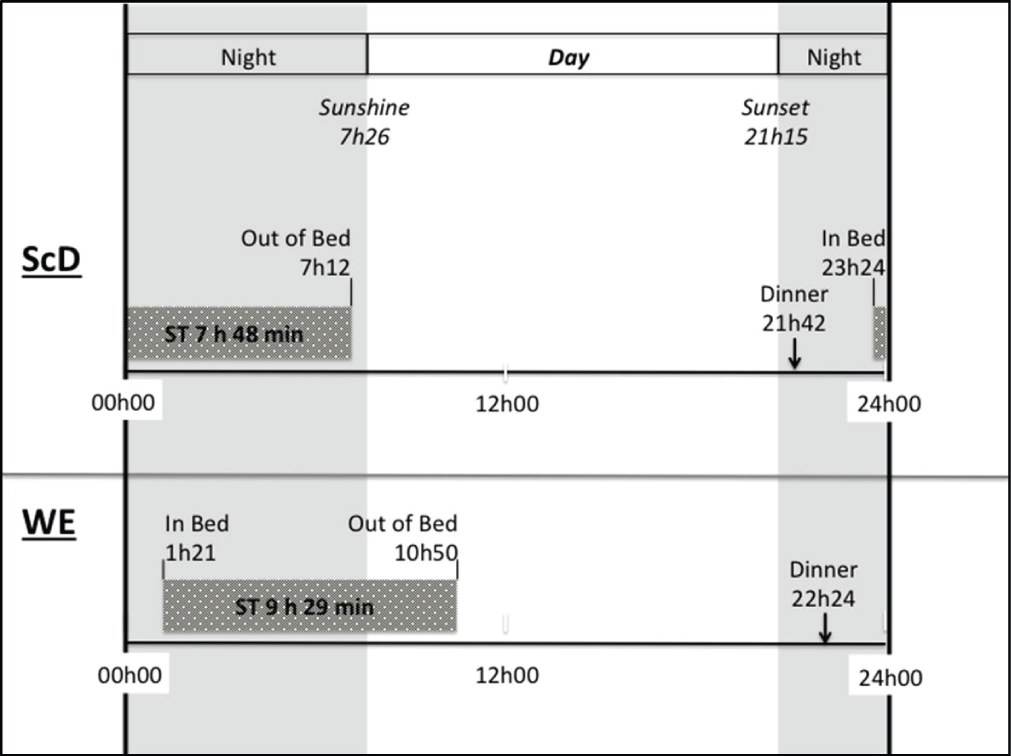
In figure 1 night sleep time, dinnertime as well as daylight cycle are synoptically resumed.
Statistical associations
We looked for statistical association between reported habits and sleep variables. The results are summarized in table 2. The use of electronic devices during the night correlated with night sleep time during school days and weekends, and with insufficient sleep. Furthermore, doing physical activity correlated with night sleep time during school days as well as with sleep debt and insufficient sleep.
Discussion
The dynamic relation between development and sleep, in adolescents, was classically defined as the “perfect storm” [36]. In this model, circadian phase delay and slowed rise of sleep pressure are factors that push toward a late bedtime. In the same direction act psychosocial factors as bedtime autonomy, academic pressure, screen time and social networking. On the other hand, the school start time requires an early rise time in the morning. The resultant between the late bedtime and the early rise time is short sleep.
As we stated in the introduction, it is very difficult to establish normative data about sleep duration in adolescents. The World Health Organization [37] reported that prepubescent children sleep about 10 hours a night, mid adolescents 8.5 hours, and older adolescents about 7 hours a night. Night sleep time in our population during school day is probably less than expected. We found that 13 years old subjects sleep 8 hours 19 minutes and 19 years old subjects sleep 6 hours 50 minutes. Furthermore, the percentage of subjects sleeping 7 hours or less increase with age. On the other hand, it is interesting to note that sleep debt (defined as a difference of two or more hours, between sleep time during week and sleep time during school days) do not increase significantly with age. The sleep debt may be considered as an attempt to compensate, during the weekend, the relative sleep deprivation accumulated during school days. So, the question that arises is the following: if our older adolescents sleep lees during school days and they do not increase sleep debt, how can they compensate their relative sleep deprivation? We think that the answer is by increasing nap. The percentage of subjects having a nap increases with age, both during school days and during weekend. Total sleep time (night sleep time + nap) still significant decrease with age during school day, but not during weekend. So, having a nap, especially during weekend, tends to compensate the reduction of total sleep time across the age. In this context, we have to remember that in our environment, public school classes start at 8-8.15 a.m. and end at 2.30-2.45 p.m. Hence the students have the possibility to have a nap after lunch both during school days and weekend.
The proportion of subjects using electronic devices and social network during the night increases with age. This is a result that we expected and that is extensively described in the literature. In the same direction, we found an increasing number of subjects with sleep initiating problems when age increase. Alerting stimuli from electronic devices together with an increased autonomy, in the older adolescents, can cause a disruption of sleep habits and routines at night. It is remarkable that the use of electronic devices at night correlates significantly with night sleep time and with the number of subjects having an insufficient sleep (Table 2).
An important finding is the practice of physical activity. The proportion of subjects doing physical activity or sport dramatically decreases with age among adolescents. This observation is known from a long time [38]. What we found in our group is that the sedentariness correlates with shorter sleep time during school day, sleep debt and insufficient sleep. The design of the study does not permit to establish a causal relationship. Anyway, we can argue that physical activity and sport augment sleep pressure, resulting in an increased duration of sleep.
Finally, we will discuss another crucial aspect. It is known that light is one of the primary synchronizing agents for the human circadian clock and for sleep-wake cycle. The study was planned to control this variable. At this scope all the questionnaires were completed between the days 1st and 10th of May. It was more than one month after the transition involved in daylight saving time (turning clocks forward by an hour in the spring). In this 10 days period, in Seville, the average time of sunshine was at 7.26 and the average time of sunset was at 21.15 (Figure 1). If we assume that dim light melatonin onset usually occurs about two hours before habitual sleep time, it is not surprising to register this sleep schedule at night during school days. During weekend, social activities are probably the principal cause of the late sleep schedule. Dinnertime is another factor, that in a given population, may be related with sunset and social habits, and that can contribute to sleep schedules. During school days subjects have dinner half an hour after the sunset. During weekend they have dinner approximately one hour after the sunset.
We will conclude this discussion with a short digression about the particular time zone of Spain, because it seems to have significant implications. Continental Spain uses a time zone corresponding, in the period of the study, to Central European Summer Time. Seville is situated at the southwest of Spain and its coordinates are 37° 23’ N, 5° 59’ W [39]. Let’s try to compare with another city with similar latitude and same time zone. For example, Syracuse (Sicily, Italy) has approximately the same latitude 37° 4’ N, an eastern longitude 15° 17’ E, and the same time zone. In the same period in which our study was carried out, in Syracuse sunshine was at 6.00 and sunset was at 19.52, that is more than one hour before than Seville. With the similar latitude, Seville and Syracuse have the same hours of light during the day. Due to the use of the same time zone, light phase is delayed in Seville respect to Syracuse. For this reason, the current time zone used in continental Spain may contribute to a relative delayed phase shift. In the context of the “perfect storm” model cited above, current time zone, for continental Spain, is another important factor that could push toward a late bedtime in our population. In the same viewpoint, Portugal border is at 150 km from Seville, westward, and Portugal has different time zone, one hour less than Spain. Vila Real de Santo Antonio, is the first town when arriving in Portugal from Seville. Its coordinates are 37° 12’ N, 7° 25’ W (similar to Seville). In Vila Real de Santo Antonio sunshine and sunset, in the same period of our study, were at 6.31 and 20.23 respectively, still approximately one hour before than Seville
In conclusion, as expected, our adolescents show a progressive deterioration of sleep habits and a decrease of sleep time across the age. In our particular context two findings can be outlined. Time zone and social habits (dinner time) can contribute to a late bedtime; and nap in the afternoon is a possible mechanism to compensate short night sleep time in older adolescents.
- Siegel JM. Sleep viewed as a state of adaptive inacti vity. Nat Rev Neurosci. 2009; 10: 747-753. PubMed: https://pubmed.ncbi.nlm.nih.gov/19654581/
- Tononi G, Cirelli C. Sleep function and synaptic homeostasis. Sleep Med Rev. 2006; 10: 49-62.PubMed: https://pubmed.ncbi.nlm.nih.gov/16376591
- Diekelmann S, Born J. The memory function of sleep. Nat Rev Neurosci. 2010; 11: 114-126. PubMed: https://pubmed.ncbi.nlm.nih.gov/20046194/
- Siegel JM. Clues to the functions of mammalian sleep. Nature. 2005 437: 1264-1271. PubMed: https://pubmed.ncbi.nlm.nih.gov/16251951/
- Lee JA, Park HS. Relation between sleep duration, overweight, and metabolic syndrome in Korean adolescents. Nutr Metab Cardiovasc Dis. 2013. PubMed: https://pubmed.ncbi.nlm.nih.gov/24188647/
- Mitchell JA, Rodriguez D, Schmitz KH, Audrain McGovern J. Sleep duration and adolescent obesity. Pediatrics. 2013; 131: 1428-1434. PubMed: https://pubmed.ncbi.nlm.nih.gov/23569090/
- Eisenmann JC, Ekkekakis P, Holmes M. Sleep duration and overweight among Australian children and adolescents. Acta Paediatr. 2006; 95: 956-963. PubMed: https://pubmed.ncbi.nlm.nih.gov/16882569/
- Azadbakht L, Kelishadi R, Khodarahmi M, Qorbani M, Heshmat R, Motlagh ME, et al. The association of sleep duration and cardiometabolic risk factors in a national sample of children and adolescents: The CASPIAN III study. Nutrition. 2013; 29: 1133-1141. PubMed: https://pubmed.ncbi.nlm.nih.gov/23927946/
- Klingenberg L, Chaput JP, Holmback U, Visby T, Jennum P, Nikolic M, et al. Acute sleep restriction reduces insulin sensitivity in adolescent boys. Sleep. 2013; 36: 1085-1090. PubMed: https://pubmed.ncbi.nlm.nih.gov/23814346/
- Matthews KA, Dahl RE, Owens JF, Lee L, Hall M. Sleep duration and insulin resistance in healthy black and white adolescents. Sleep. 2012; 35: 1353-1358. PubMed: https://pubmed.ncbi.nlm.nih.gov/23024433/
- Gangwisch JE, Malaspina D, Babiss LA, Opler MG, Posner K, Shen S, et al. Short sleep duration as a risk factor for hypercholesterolemia: Analyses of the national longitudinal study of adolescent health. Sleep. 2010; 33: 956-961.PubMed: https://pubmed.ncbi.nlm.nih.gov/20614855/
- Bel S, Michels N, De Vriendt T, Patterson E, Cuenca-García M, Diethelm K, et al. HELENA Study Group. Association between self-reported sleep duration and dietary quality in European adolescents. Br J Nutr. 2013; 110: 949-959. PubMed: https://pubmed.ncbi.nlm.nih.gov/23506795/
- Golley RK, Maher CA, Matricciani L, Olds TS. Sleep duration or bedtime? Exploring the association between sleep timing behaviour, diet and BMI in children and adolescents. Int J Obes (Lond). 2013; 37: 546-551. PubMed: https://pubmed.ncbi.nlm.nih.gov/23295498/
- Garaulet M, Ortega FB, Ruiz JR, Rey Lopez JP, Beghin L, Manios Y, et al. Short sleep duration is associated with increased obesity markers in European adolescents: effect of physical activity and dietary habits. The HELENA study. Int J Obes (Lond). 2011; 35: 1308-1317. https://go.nature.com/2Xl2EFF
- Conden E, Ekselius L, Aslund C. Type D personality is associated with sleep problems in adolescents. Results from a population-based cohort study of Swedish adolescents. J Psychosom Res. 2013; 74: 290-295. PubMed: https://pubmed.ncbi.nlm.nih.gov/23497829/
- Talbot LS, McGlinchey EL, Kaplan KA, Dahl RE, Harvey AG. Sleep deprivation in adolescents and adults: changes in affect. Emotion. 2010; 10: 831-841. PubMed: https://pubmed.ncbi.nlm.nih.gov/21058849/
- Wojnar J, Brower KJ, Dopp R, Wojnar M, Emslie G, Rintelmann J, et al. Sleep and body mass index in depressed children and healthy controls. Sleep Med. 2010; 11: 295-301. PubMed: https://pubmed.ncbi.nlm.nih.gov/20138579/
- Fitzgerald CT, Messias E, Buysse DJ. Teen sleep and suicidality: Results from the youth risk behaviour surveys of 2007 and 2009. J Clin Sleep Med. 2011; 7: 351-356. PubMed: https://pubmed.ncbi.nlm.nih.gov/21897771/
- Arman AR, Ay P, Fis NP, Ersu R, Topuzoglu A, Isik U, Berkem M. Association of sleep duration with socio-economic status and behavioural problems among schoolchildren. Acta Paediatr. 2011; 100: 420-424. PubMed: https://pubmed.ncbi.nlm.nih.gov/20860707/
- Singh GK, Kenney MK. Rising prevalence and neighborhood, social, and behavioral determinants of sleep problems in US children and adolescents, 2003-2012. Sleep Disord. 2013: 394320. PubMed: https://pubmed.ncbi.nlm.nih.gov/23819057/
- Billows M, Gradisar M, Dohnt H, Johnston A, McCappin S, Hudson J. Family disorganization, sleep hygiene, and adolescent sleep disturbance. J Clin Child Adolesc Psychol. 2009; 38: 745-52. PubMed: https://pubmed.ncbi.nlm.nih.gov/20183658/
- King DL, Gradisar M, Drummond A, Lovato N, Wessel J, Micic G, et al. The impact of prolonged violent video gaming on adolescent sleep: An experimental study. J Sleep Res. 2013; 22:137-143. PubMed: https://pubmed.ncbi.nlm.nih.gov/23137332/
- Choi K, Son H, Park M, Han J, Kim K, Lee B, et al. Internet overuse and excessive daytime sleepiness in adolescents. Psychiatry Clin Neurosci. 2009; 63: 455-462. PubMed: https://pubmed.ncbi.nlm.nih.gov/19490510/
- Jiang F, VanDyke RD, Zhang J, Li F, Gozal D, Shen X. Effect of chronic sleep restriction on sleepiness and working memory in adolescents and young adults. J Clin Exp Neuropsychol. 2011; 33: 892-900. PubMed: https://pubmed.ncbi.nlm.nih.gov/21950514/
- Dewald Kaufmann JF, Oort FJ, Meijer AM. The effects of sleep extension on sleep and cognitive performance in adolescents with chronic sleep reduction: an experimental study. Sleep Med. 2013; 14:510-517. PubMed: https://pubmed.ncbi.nlm.nih.gov/23523432/
- Huang YS, Wang CH, Guilleminault C. An epidemiologic study of sleep problems among adolescents in North Taiwan. Sleep Med. 2010 11: 1035-1042. PubMed: https://pubmed.ncbi.nlm.nih.gov/20724214/
- Kim SJ, Lee YJ, Cho SJ, Cho IH, Lim W. Relationship between weekend catch-up sleep and poor performance on attention tasks in Korean adolescents. Arch Pediatr Adolesc Med. 2011; 165: 806-812. https://bit.ly/2TRJdlB
- Yilmaz K, Kilinçaslan A, Aydin N, Kul S. Understanding sleep habits and associated factors can help to improve sleep in high school adolescents. Turk J Pediatr. 2011; 53: 430-436. PubMed: https://pubmed.ncbi.nlm.nih.gov/21980846/
- Wells JC, Hallal PC, Reichert FF, Menezes AM, Araujo CL, Victora CG. Sleep patterns and television viewing in relation to obesity and blood pressure: Evidence from an adolescent Brazilian birth cohort. Int J Obes (Lond). 2008; 32: 1042-1049. https://go.nature.com/2XRxWCQ30. Thorleifsdottir B, Bjornsson JK, Benediktsdottir B, Gislason T, Kristbjarnarson H. Sleep and sleep habits from childhood to young adulthood over a 10 year period. J Psychosom Res. 2002; 53: 529-37. PubMed: https://bit.ly/2zRF61U
- Thorleifsdottir B, Bjornsson JK, Benediktsdottir B, Gislason T, Kristbjarnarson H. Sleep and sleep habits from childhood to young adulthood over a 10 year period. J Psychosom Res. 2002; 53: 529-37. PubMed: https://bit.ly/2zRF61U
- Jenni OG. How much sleep is "normal" in children and adolescents? JAMA Pediatr. 2013; 167: 91-92. https://bit.ly/3dmfhWd
- Williams JA, Zimmerman FJ, Bell JF. Norms and trends of sleep time among US children and adolescents. JAMA Pediatr. 2013; 167: 55-60. PubMed: https://pubmed.ncbi.nlm.nih.gov/23403646/
- Ohayon M, Carskadon MA, Guilleminault C, Vitiello M. Meta-analysis of quantitative sleep parameters from childhood to old Age in healthy individuals: Developing normative sleep values across the human lifespan. Sleep. 2004; 27: 1255-1273. PubMed: https://pubmed.ncbi.nlm.nih.gov/15586779/
- National Sleep Foundation (NSF) (2006) Sleep in America. National survey of caregivers and their adolescent children (age 11-17 and in 6th to 12th grade) living within the United States. https://bit.ly/3eDMOM8
- Leger D, Beck F, Richard JB, Godeau E. Total sleep time severely drops during adolescence. PLoS One. 2012; 7: 45204. PubMed: https://pubmed.ncbi.nlm.nih.gov/23082111/
- Carskadon MA. Sleep in adolescents: The perfect storm. Pediatr Clin North Am. 2011; 58: 637-647. PubMed: https://pubmed.ncbi.nlm.nih.gov/21600346/
- World Health Organisation (WHO) technical meeting on sleep and health. World Health Organization regional office for europe european centre for environment and health bonn office. WHO publications, Copenhagen, Denmark. 2005; 183. https://bit.ly/2AmDzkt
- Centers for Disease Control and Prevention. Guidelines for school and community programs to promote lifelong physical activity among young people. MMWR Recomm Rep. 1997; 46: 1-36. https://bit.ly/2TVowVZ
- https://bit.ly/3ezkU3N
Sign up for Article Alerts