Impact of Recurvatum on the Recovery after Anterior Cruciate Ligament (ACL) Surgery
Pauline Six1*, Jeremie Caudin2 and Andre Thevenon1
1CHU, Lille 59000-F, France
2Centre Calvé, Berck 62600-F, France
*Address for Correspondence: Pauline Six, CHU, Lille 59000-F, Certified in Sport Biology, France, Tel: +032-044-5824; Fax: +032-044-5853; E-mail: [email protected]
Submitted: 12 February 2019; Approved: 22 February 2019; Published: 23 February 2019
Citation this article: Six P, Caudin J, Thevenon A. Impact of Recurvatum on the Recovery after Anterior Cruciate Ligament (ACL) Surgery. Int J Sports Sci Med. 2019;3(1): 018-023.
Copyright: © 2019 Six P, et al. This is an open access article distributed under the Creative Commons Attribution License, which permits unrestricted use, distribution, and reproduction in any medium, provided the original work is properly cited
Download Fulltext PDF
Recurvatum is generally considered to be a risk factor for graft tendon failure and a probable risk factor for native ACL failure. To evaluate the impact of recurvatum and the type of ACL repair on the hamstring/ quadriceps (H/ Q) ratio 4 months after surgery.
103 patients having undergone ACL surgery were included between July 1st, 2017, and July 1st, 2018. A clinical check-up and an isokinetic test were performed 4 months after surgery. The H/ Q ratio was calculated and then assessed as a function of the type of surgery and the presence or absence of recurvatum.
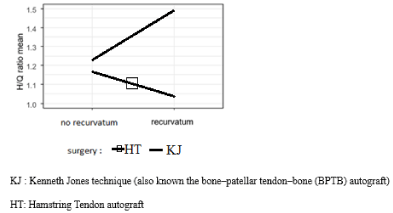
The mean H/ Q ratio on the operated side did not differ significantly (p = 0.87) when comparing patients with recurvatum (1.2) and those without (also 1.2). The interaction between the type of surgery and recurvatum was statistically significant (p = 0.019). In patients with recurvatum, the mean H/ Q ratio was 1.49 in the BPTB group and 1.04 in the HT group.
Neither the presence of recurvatum nor the type of surgery alone was related to the H/ Q ratio on the operated side. However, the interaction between surgery and recurvatum was statistically significant. BPTB technique should be preferred to the HT technique in patients with recurvatum.
Introduction
Anterior Cruciate Ligament (ACL) failure is a very common sports injury. According to the French health authorities, 35,500 operations for ACL failure took place in France in 2006, and the prevalence of this injury continues to rise [1]. Indeed, ACL repair is the most frequently performed operation in sports medicine, with the goal of stabilizing the knee joint and preventing instability [1]. The most common surgical ACL repair procedures are the Bone–Patellar Tendon–Bone (BPTB) autograft (also known as the Kenneth Jones technique) and the Hamstring Tendon (HT) autograft. There are currently no guidelines on the choice of the surgical technique for ACL repair; each surgeon has his or her own preference, and each technique has advantages and disadvantages. However, the frequency and time scale of muscle function recovery differ from one technique to another [2,3]. Although many studies have addressed this problem, a consensus has not emerged [4-6]. However, it appears that the key to success is good graft positioning, rather than the choice of the technique per se; two thirds of surgical failures are caused by poor positioning [7]. The initial tensioning and the primary fixation’s solidity and stability over time are critical factors [7].
Isokinetic strength training [8] is frequently prescribed as a rehabilitation technique following surgical ACL repair. It enables the accurate quantification of the force produced by muscles commonly involved in knee pathologies (the quadriceps and the hamstrings, in ACL failure), and serves as a guide to rehabilitation and the resumption of sports activities. Some parameters are measured [9], and others are calculated. According to the literature, the hamstring/quadriceps (H/ Q) functional ratio (defined by Croisier, et al. in 1996 as the ratio between the force generated by eccentric contraction of the hamstrings at 30°/ s and the force generated by concentric contraction of the quadriceps at 240°/ s) best reflects the knee’s physiological status. A ratio above 0.9 is normal, whereas a ratio below 0.8 is pathologic [10]. This muscle evaluation technique is increasingly being used to assess top-level athletes [10,11].
Knee recurvatum is characterized by a femur-tibia angle of 5° or more in the sagittal plane. Recent publications [12,13] (including one from the Multicenter ACL Revision Study (MARS) group [12]) have demonstrated that recurvatum is a risk factor for graft tendon failure and a probable risk factor for native ACL failure (with a statistically significant odds ratio [95% Confidence Interval (CI)] of 2.12 (1.1-4.7)). In the MARS, the prevalence of recurvatum in patients with ACL rupture was 33% [12].
Kim et al. [14] hypothesized that patellar tendon grafts are more stable than hamstring tendon grafts in patients with knee hyperextension. This hypothesis has yet to be validated experimentally.
Myer et al. [15] found that knee hyperlaxity might increase the risk of ACL failure. These observations and hypotheses raise questions about the best rehabilitation and surgical strategies for optimizing recovery and preventing the recurrence of ACL failure in patients with recurvatum. This topic has already been addressed by a Japanese study published in 2011 [16]; Kawahara et al. [17] suggested that the presence of recurvatum should be taken into account during rehabilitation following ACL injury. Furthermore, hyperextension also constitutes a challenge for the surgeon. It has been shown that the loss of extension after ACL reconstruction has a negative impact on the outcome, with an increased risk of radiographic osteoarthritis. The MARS study has shown that hyperextension is a risk factor for graft rupture [12]. The surgeon must consider the risk benefit balance between hyperextension on one hand and loss of extension on the other.
The primary objective of the present study was to evaluate the impact of recurvatum and the type of ACL repair surgery on a functional outcome: the H/ Q ratio in an isokinetic test performed 4 months after surgery. The study’s secondary objectives were to (i) estimate the prevalence of recurvatum in patients undergoing surgery after ACL rupture, (ii) evaluate the impact of recurvatum on the functional performance of healthy knees (i.e. in the absence of ACL rupture or other types of traumatic knee injury), and (iii) analyze the contexts in which the ACL fails (sports training, skiing accidents, etc.).
Materials and Methods
We performed a retrospective analysis of data collected by a sports medicine clinic over a 12-month period between July 1st, 2017, and July 1st, 2018. The study participants had been referred by seven private- and public-sector hospitals in northern France. The two main inclusion criteria were surgical ACL repair (using BPTB or HT autograft techniques), and referral by the orthopedic surgeon to our sports medicine clinic for an isokinetic test at 4 months post-surgery. The main non-inclusion criteria were a history of homolateral or contralateral ACL failure, ACL surgery, tendon damage, muscle-tendon surgery or meniscectomy, a contraindication to isokinetic testing, and the performance of an isokinetic test with parameters other than those specified in the study protocol. Patients who did not receive the study information sheet or refused to participate were not included in the study.
For each participant, a clinical check-up and an isokinetic test were performed during the same sports medicine consultation 4 months after surgery. Isokinetic active movement is defined as to a dynamic muscle contraction with (i) displacement of the limb segment at a constant speed over the entire range of motion, and (ii) a variable, self-adapting resistance (10). All isokinetic tests were performed on the same dynamometer from MEDIMEX Company (HUMAC® NORM™, Computer Sports Medicine, Inc., Stoughton, MA). After a general warm-up on a cycle ergometer, the participant performed a specific isokinetic warm-up routine on the dynamometer. The speeds and contraction modes were the same as in the recorded test run.
The participant first performed two series of three concentric-mode contractions of the quadriceps at 90°/ s, with a 60-second recovery period between the two. The first series served as a warm-up, and the second was recorded for analysis. Next, the participant performed two series of five concentric-mode contractions of the quadriceps at 240°/ s. Again, there was a 60-second recovery period between the two series, and the second series was recorded for analysis. Lastly, the participant performed two series of three eccentric-mode contractions of the hamstrings at 30°/ s, with a 60-second recovery period between the two. Again, the second series was recorded for analysis. The participants were told to perform a maximal effort during the test series but not during the warm-up series. We then calculated the H/ Q functional ratio, defined as the ratio between the force generated by eccentric contraction of the hamstrings at 30°/ s and the force generated by concentric contraction of the quadriceps at 240° [11].
Demographic and clinical data concerning the study participants (such as age, weight, height, and the date and type of surgery) were extracted from their electronic medical records.
Statistical analyses
One classic guideline (Agresti 2007) [18] suggest that there should be 10 cases for each predictors included in the logistic regression. Given that the prevalence of recurvatum among patients with ACL failure is around 33%, and that 3 predictors will be included, we calculated that 100 patients would have to be included.
We first performed a descriptive analysis of the data. Quantitative variables were described as the mean ± Standard Deviation (SD) or the median [Interquartile Range (IQR)], and qualitative variables were described as the number (percentage). When considering patients with recurvatum, the 95%CI was calculated for all variables. Differences between patients with recurvatum and those without were evaluated by using Student’s test (or the Mann-Whitney-Wilcoxon test, for non-normal data distributions) for quantitative variables and a Chi-squared test (or Fisher’s test, for small sample sizes) for qualitative variables. Distributions has been assessed by Shapiro-Wilk test.
In order to study the correlation between the H/ Q functional ratio for the operated side and that on the healthy side, we calculated Spearman’s coefficient (given the non-normal data distribution) and its 95% CI for the study population as a whole and for the subsets of patients with or without recurvatum. To study the impact of recurvatum and the type of surgery on the functional performance of the operated leg, we performed a multivariate multiple linear regression analysis. The study variable was the H/ Q functional ratio on the operated side, and the explanatory variables were the H/ Q functional ratio on the healthy side, the type of surgery, and the presence of recurvatum. “Outlier” patients with a highly abnormal functional ratio on the operated side were excluded from this analysis. The conditions for application of a multivariate multiple linear regression (the normality of residues, and heteroscedasticity) were met. The regression’s correlation coefficient (R²) was estimated by repeating a 10-fold cross-validation procedure 1000 times.
The threshold for statistical significance was set to p < 0.05 for all analyses. All statistical analyses were carried out with R software (version 3.4.2) [19].
Results
We included 103 patients: 80 males (77.7%) and 23 females (12.3%). The characteristics of the study population are described in table 1. Twenty-eight participants (27.2%; 95% CI = [18.6%, 35.8%]) had recurvatum, 48 patients (46.6%) had undergone surgery on the left knee, 44 (42.7%) had undergone a BPTB autograft, and 59 (57.3%) had undergone an HT autograft. Nine patients (10.2%) had suffered a single traumatic injury, and 1 patient (1.1%) had suffered multiple trauma. The other patients were injured during sports activities: 48 during soccer (54.5%), 14 when skiing (15.9%), 4 during basketball (4.5%), 4 during judo (4.5%), 3 during handball (3.4%), 2 during rugby (2.3%), 1 during volleyball (1.1%), 1 during gymnastics (1.1%), and 1 during badminton (1.1%) (Figure 1).The mean (range) H/ Q ratio on the healthy side was 1.1, with a minimum of 0.1 and a maximum of 3.1. The mean H/ Q ratio of operated side was 1.2, with a minimum of 0.1 and a maximum of 3.1 also.
We performed bivariate analyses to investigate the difference between patients with recurvatum and those without (Table 1). There was no intergroup difference in the proportion of male patients (74.7% among patients without recurvatum and 85.7% among those with recurvatum; p = 0.35). None of the qualitative variables were significantly related to the presence of recurvatum. In the subgroup without recurvatum, 36 patients (48%) had undergone BPTB surgery; this proportion was 28.6% in the recurvatum subgroup (p = 0.12).
The mean body weight was significantly higher in patients without recurvatum (72.9 kg) than in patients with recurvatum (78.9) kg (p = 0.042).
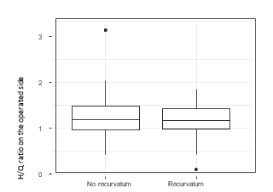
The mean H/ Q ratio on the healthy side was 1.0 in patients without recurvatum and 1.1 in patients with recurvatum; these ratios did not differ significantly (p = 0.8). The mean H/ Q ratio on the operated side was 1.2 in patients without recurvatum, and 1.2 in patients with recurvatum; again, these ratios did not differ significantly (p = 0.87) (Figure 2). Given that an increase in the H/ Q ratio does not indicate whether it is close to the target value, we also compared the H/ Q ratio on the operated side with the normal value (0.9) as a function of the recurvatum status. The difference was not significant (p = 0.87).
In order to evaluate the impact of recurvatum and type of surgery on the participants’ isokinetic test performance, we performed a multivariate analysis. We first calculated Spearman’s coefficient [95% CI] for the correlation between the H/ Q ratio on the operated side and that on the healthy side (Table 2). For the study population as a whole, the coefficient was 0.44 [0.26, 0.59], corresponding to a medium correlation. The correlation was larger in patients with recurvatum (0.55 [0.23, 0.76]) and smaller in patients without recurvatum (0.39 [0.17, 0.59]). For the regression model, a patient with an H/ Q ratio on the operated side of 3.15 was considered to be an outlier, and was excluded from the analysis (Table 3). The R² (derived by 10-fold cross-validation) was 0.25. This value corresponds to low explanatory power: only 25% of the variance in the H/ Q ratio on the operated side was accounted for by the model’s explanatory variables, and so the remaining 75% were presumably accounted for by variables not included in the model or by intrinsic variability.
For a one-unit increment in the H/ Q ratio on the healthy side, the H/ Q ratio on the operated side increased by 0.34 units (p = 0.00013). Neither the presence of recurvatum nor the type of surgery alone were related to the H/ Q ratio on the operated side. However, the interaction between type of surgery and recurvatum was statistically significant (p = 0.019): the H/ Q ratio on the operated side was 0.37 units higher for patients with recurvatum having undergone BPTB surgery than for all the other patients. This finding was confirmed by the graph in figure 3, showing the difference in the mean H/ Q ratio on the operated side as a function of the presence of recurvatum and the type of surgery. In patients with recurvatum, the mean H/ Q ratio was 1.49 for those having undergone BPTB surgery, and 1.04 for those having undergone HT surgery. In patients without recurvatum, the difference was much smaller: 1.23 for patients having undergone BPTB surgery, and 1.17 for patients having undergone HT surgery.
Discussion
Our main finding was that when considered alone, neither the presence of recurvatum nor the type of surgery was related to the H/ Q ratio on the operated side. However, the interaction between the type of surgery and the presence of recurvatum was statistically significant (p = 0.019); the H/ Q ratio on the operated side was 0.37 units greater for patients with recurvatum having undergone BPTB surgery that for all the remaining patients. We therefore conclude that BPTB surgery should be preferred to HT surgery in patients with recurvatum.
We found a higher proportion of males (85.7%, n = 44) among patients with recurvatum than among patients without recurvatum (74.7%, n = 56). However, this difference was not statistically significant (p = 0.35). The H/ Q ratio on the healthy side and the presence of recurvatum (on either the heathy side or the operated side) were not related. Despite the high prevalence of recurvatum among patients undergoing ACL surgery (around 30% in the MARS [12] and 27.2% in the present study), we did not find any literature data on the relationship between recurvatum status and the H/ Q ratio.
The majority of ACL fails occur during sport activities and especially during soccer (54.5%) and skiing (15.9%).
This risk of injury among footballers has been highlighted in other studies and prevention strategies have been implemented, such as the FIFA 11+ program in France [19]. A previous study using the FIFA 11+ program has highlighted the value of a preventive bilateral rehabilitation program [19]. The sample consisted of 6,344 soccer players, comprising 3,307 (52%) in the intervention group (the FIFA 11+ program) and 3,037 (48%) in a control group. The injury rate was 24% (n = 779) in the FIFA 11+ group and 40% (n = 1,219) in the control group had injuries; hence, the incidence of injury was around a third lower in the FIFA 11+ group, with an estimated relative risk [95%CI] of 0.70 [0.52-0.93] (p = 0.01).
Our study had a number of strengths. From a technical viewpoint, we used the same isokinetic dynamometer for all our patients, and all the measurements were performed by the same experienced investigator (who performs around 250 tests a year). This probably increased the reliability and accuracy of our results. Furthermore, our multisite patient recruitment might have reduced the heterogeneity of the study population and thus enhanced the clinical relevance of our results.
Although our prespecified recruitment target of 100 patients was achieved, the sample size was still relatively small; this explains the width of the 95%CIs mentioned above (e.g. [18.6% - 35.8%] for the prevalence of recurvatum).
As mentioned above, patients with recurvatum having undergone BPTB surgery had an H/ Q ratio on the operated leg 0.37 units greater than the remaining patients did. However, the low R² value indicates that non-included factors had a marked influence, and so the model should not be used to make predictions. These variables might correspond to other, as-yet unidentified risk factors for ACL failure. Hewett, et al. recently listed known modifiable and non-modifiable risk factors for non-contact ACL rupture [20]; not all of these were included in our model. The non-modifiable intrinsic factors are female sex [21-24], intercondylar notch depth (26), ACL volume, tibial slope, ligament hyperlaxity, lower limb morphology [25] (varus + internal hip rotation, valgus + external knee rotation, hind foot valgus, and navicular collapse), a history of ACL injury, a genetic predisposition [26], collagen disease (Ehlers-Danlos syndrome, Marfan syndrome, etc.). The modifiable factors include both intrinsic variables (BMI, neuromuscular impairments, biomechanical impairments, hormonal status, and physical and cognitive fatigue) and extrinsic variables (soccer wear, the playing surface, weather conditions, the level of competition, and sports that involve pivoting).
Our study suffered from selection bias because some patients with ACL rupture do not undergo isokinetic testing during their follow-up. One can hypothesize that the most active patients are more likely to attend a consultation and perform tests to optimize their recovery.
Another source of selection bias might be related to our exclusion of patients with a history of surgery. Since hyperextension is a risk factor for graft rupture [12], we might have inadvertently excluded patients with recurvatum. The prevalence of recurvatum in the patient population might therefore been underestimated.
Clinical Relevance
Improvement on the muscle recovery after anterior cruciate ligament surgery in patients with a recurvatum
Conclusion
Neither the presence of recurvatum nor the type of surgery alone was related to the H/ Q ratio on the operated side. However, the interaction between surgery and recurvatum was statistically significant. BPTB technique should be preferred to the HT technique in patients with recurvatum. Further research is needed to confirm or refute the present results.
Acknowledgement
We thank the Institut Calot (Berck, France), La Clinique des Acacias (Cucq, France), Le Centre Hospitalier de l’Arrondissement de Montreuil sur Mer (Montreuil sur Mer, France), La Clinique des 2 Caps (Coquelles, France), L’Hopital Privé de Villeneuve d’Ascq (Villeneuve d’Ascq, France), La Clinique de Saint Omer (Saint Omer, France) and La Clinique Villette (Dunkerque, France) for their participation in the study.
Declarations
We received financial support (notably for mailing out study information sheets to the patients) from the charities Hopale Sport Health and Association Pour la Promotion de la Rééducation Lilloise, and the company MEDIMEX.
We have no conflicts of interest with regard to these organizations in particular or the present study in general.
This study is a retrospective study using data from our usual care procedures. Thus, according to the French law, we did not need an authorization from the Ethics agency. (https://www.legifrance.gouv.fr.) Nevertheless this study has been submitted and approved by the Hospital ethic committee. The data in the study are not made public. However, they are available to reviewers and the editor of the journal if they wish.
- Joseph AM, Collins CL, Henke NM, Yard EE, Fields SK, Comstock RD. A multisport epidemiologic comparison of anterior cruciate ligament injuries in high school athletics. J Athl Train 2013; 48: 810-817. https://goo.gl/TRdj8b
- Witvrouw E, Bellemans J, Verdonk R, Cambier D, Coorevits P, Almqvist F. Patellar tendon vs. doubled semitendinosus and gracilis tendon for anterior cruciate ligament reconstruction. Int Orthop. 2001; 25: 308-311. https://goo.gl/TTgswi
- Xie X, Liu X, Chen Z, Yu Y, Peng S, Li Q. A meta-analysis of bone-patellar tendon–bone autograft versus four-strand hamstring tendon autograft for anterior cruciate ligament reconstruction. The Knee. 2015; 22: 100-110. https://goo.gl/zTBY2w
- Malliopoulos X, Courtot H, Caudin J, Facquez T, Bouilland S, Baert D, et al. Early isokinetic test after anterior cruciate ligamentoplasty: results and conclusions. J Traumatol Sport. 2013; 30: 216-219.
- Condouret J, Cohn J, Ferret J-M, Lemonsu A, Vasconcelos W, Dejour D, et al. Isokinetic assessment with two years follow-up of anterior cruciate ligament reconstruction with patellar tendon or hamstrings tendons. Rev Chir Orthopédique Réparatrice Appar Mot. 2008; 94: 375-382. https://goo.gl/fXZanj
- Dauty M, Le Brun J, Huguet D, Paumier S, Dubois C, Letenneur J. Return to pivot-contact sports after anterior cruciate ligament reconstruction: patellar tendon or hamstrings autografts. Rev Chir Orthopédique Réparatrice Appar Mot. 2008; 94: 552-560. https://goo.gl/XDkXK9
- Thaunat M, Fayard JM, Sonnery-Cottet B. Hamstring tendons or bone-patellar tendon-bone graft for anterior cruciate ligament reconstruction? Orthop Traumatol Surg Res. 2019; 105: S89-S94. https://goo.gl/M2C5k7
- Edouard P, Derache F. Isokinetic guide: isokinetic evaluation of concepts to sports and pathological conditions. 1st ed. Elsevier Masson; 2016.
- Croisier JL, Crielaard JM. Exploration isocinétique: analyse des paramètres chiffrés. Annals of Rehabilitation and Physical Medicine. 1999; 42: 538-545. https://goo.gl/RnhCYm
- Croisier JL, Crielaard JM. Experience with isokinetics in athletes. J Traumatol Sport 2004; 21: 238-243.
- Dauty M, Menu P, Fouasson-Chailloux A, Ferréol S, Dubois C. Prediction of hamstring injury in professional soccer players by isokinetic measurements. Muscles Ligaments Tendons J. 2016; 6: 116-123. https://goo.gl/Hqx4qL
- The MARS Group, Cooper DE, Dunn WR, Huston LJ, Haas AK, Spindler KP, et al. Physiologic preoperative knee hyperextension is a predictor of failure in an anterior cruciate ligament revision cohort: a report from the MARS Group. Am J Sports Med. 2018; 46: 2836-2841. https://goo.gl/dqZnNe
- Ueki H, Nakagawa Y, Ohara T, Watanabe T, Horie M, Katagiri H, et al. Risk factors for residual pivot shift after anterior cruciate ligament reconstruction: data from the MAKS group. Knee Surg Sports Traumatol Arthrosc. 2018; 26: 3724-3730. https://goo.gl/oV3JDF
- Kim SJ, Moon HK, Kim SG, Chun YM, Oh KS. Does severity or specific joint laxity influence clinical outcomes of anterior cruciate ligament reconstruction? Clin Orthop Relat Res. 2010; 468: 1136-1141. https://goo.gl/zXGvAP
- Myer GD, Ford KR, Paterno MV, Nick TG, Hewett TE. The effects of generalized joint laxity on risk of anterior cruciate ligament injury in young female athletes. Am J Sports Med. 2008; 36: 1073-1080. https://goo.gl/z7DBjX
- Kawahara K, Sekimoto T, Watanabe S, Yamamoto K, Tajima T, Yamaguchi N, et al. Effect of genu recurvatum on the anterior cruciate ligament-deficient knee during gait. Knee Surg Sports Traumatol Arthrosc. 2012; 20: 1479-1487. https://goo.gl/QwtYCh
- Shelbourne KD, Gray T. Minimum 10-year results after anterior cruciate ligament reconstruction: how the loss of normal knee motion compounds other factors related to the development of osteoarthritis after surgery. Am J Sports Med. 2009; 37: 471-480. https://goo.gl/RfK2w3
- Agresti A. An Introduction to categorical data analysis. Hoboken, NJ, USA: John Wiley & Sons, Inc; 2007.
- R Core Team. R: A language and environment for statistical computing. R Foundation for Statistical Computing, Vienna, Austria. n.d. 2013.
- Hewett TE, Myer GD, Ford KR, Paterno MV, Quatman CE. Mechanisms, prediction, and prevention of ACL injuries: Cut risk with three sharpened and validated tools: ACL Iinjury prevention. J Orthop Res. 2016; 34: 1843-1855. https://goo.gl/5US8mE
- Huston LJ, Wojtys EM. Neuromuscular performance characteristics in elite female athletes. Am J Sports Med 1996; 24: 427-436. https://goo.gl/EQXLg6
- Rozzi SL, Lephart SM, Gear WS, Fu FH. Knee joint laxity and neuromuscular characteristics of male and female soccer and basketball players. Am J Sports Med. 1999; 27: 312-319. https://goo.gl/HBkgUr
- Beynnon BD, Vacek PM, Newell MK, Tourville TW, Smith HC, Shultz SJ, et al. The effects of level of competition, sport, and sex on the incidence of first-time noncontact anterior cruciate ligament injury. Am J Sports Med. 2014; 42: 1806-1812. https://goo.gl/aiAtkx
- Laux CJ, Ulbrich EJ, Andreisek G, Marcon M, Fischer MA, Mehra T, et al. Impact of graft and tunnel orientation on patient-reported outcome in anterior cruciate ligament reconstruction using bone-patellar tendon-bone autografts. J Orthop Surg. 2018; 13: 245. https://goo.gl/F4BY96
- Carlson VR, Sheehan FT, Boden BP. Video analysis of Anterior Cruciate Ligament (ACL) Injuries: a systematic review. JBJS Rev. 2016; 4: 1. https://goo.gl/nkrVi6
- Lulińska-Kuklik E, Rahim M, Domańska-Senderowska D, Ficek K, Michałowska-Sawczyn M, Moska W, et al. Interactions between COL5A1 gene and risk of the anterior cruciate ligament rupture. J Hum Kinet. 2018; 62: 65-71. https://goo.gl/BtXi96
Sign up for Article Alerts