Prevalence of Different Genotypes/Subgenotypes in Hepatitis B Virus Infected Isolates of Punjab State in North India?
Rajesh Kumar1* and Jasbir Singh2
1Lecturer (Biology), Government Senior Secondary School in Moi Hooda, Sonepat, 131301, Haryana, India
2Associate Professor, Department of Biochemistry, Kurukshetra University, Kurukshetra-136119, Haryana, India
*Address for Correspondence: Rajesh Kumar Lecturer (Biology), Government Senior Secondary School in Moi Hooda, Sonepat 131301, Haryana, Tel: +919-466-067-206; E-mail: [email protected]
Submitted: 03 November 2019; Approved: 17 December 2019; Published: 23 December 2019
Citation this article: Kumar R, Singh J. Prevalence of Different Genotypes/Subgenotypes in Hepatitis B Virus Infected Isolates of Punjab State in North India. Int J Virol Infect Dis. 2019;4(1): 011-016.
Copyright: © 2019 Kumar R, et al. This is an open access article distributed under the Creative Commons Attribution License, which permits unrestricted use, distribution, and reproduction in any medium, provided the original work is properly cited
Keywords: HBV; Genotype; Subgenotype; PCR; RFLP
Download Fulltext PDF
Different genotypes and subgenotypes of Hepatitis B virus are related to disease progression, clinical progression, response to antiviral treatment, and prognosis. There is a lack of information about genotypes/subgenotypes throughout India. Our aim was to find out the prevalence of different genotypes/subgenotypes of HBV infected people of Punjab state in North India. A total 21 HBV infected patients from Punjab state (North India) were enrolled in the present study. Genotype specific primers and nested PCR-RFLP assay were used for the detection of circulating genotypes/subgenotypes in the HBV infected population. 90% of the isolates were of genotype D (subgenotype D1 and D2) and 10% of the isolates were of genotype A (subgenotype A1).
Introduction
Hepatitis B Virus (HBV) is a small, hepatotropic and enveloped DNA virus which replicates in human hepatocytes and leads to a wide spectrum of clinic manifestation of liver disease, including acute hepatitis, fulminant liver failure, chronic hepatitis, fibrosis, cirrhosis and Hepatocellular Carcinoma (HCC) [1]. The most significant feature of HBV is its remarkable genetic diversity which is largely due to its error in replication via reverse transcription, host immune pressure and the genetic processes, like recombination and insertion/deletion [2,3]. Based on an intergroup divergence of >7.5% across the complete genome, HBV has been classified into 10 genotypes, A-J [4-8] and most genotypes are further divided into subgenotypes that differ from each other by 4-7.5% [3-9]. Currently, genotypes A, B and C have been subdivided in subgenotypes A1-A7, B1-B9 and C1-C16 while 10 subgenotypes of D (D1-D10), 4 subgenotypes of F (F1-F4) and 2 of I (I1,I2) have been described [10].
It is widely accepted that HBV-induced liver injury is primarily mediated by host immune response to viral proteins, although other studies had suggested that in absence of a functional immune system, liver pathology may also be caused by endogenous cytopathic effects of the virus itself [11,12]. Among the viral factors, HBV genotype/subgenotype has been implicated in pathogenesis and clinical outcome of HBV-infection [1].
HBV genotype A is found in Europe, Africa, and India [2,13]. HBV genotype B and HBV genotype C are mainly found in most part of Asia, including China and Japan [13,14]. The HBV genotype D is found commonly in the Mediterranean area, the Middle East and India, whereas the HBV genotype E is found in sub-Saharan Africa and also first time reported in India [2,13-19]. The HBV genotype F and HBV genotype H is only observed in Central and South America [13,20-22]. The HBV genotype G has been observed in France, Germany and United States [23-25]. Genotype I has recently been found in Vietnam and Laos [26]. The newest HBV genotype, genotype J, has been found in the Ryukyu Islands in Japan [8].
In India, a geographically large country with a history of intense heterogeneous migration, a lack of data exists regarding the distribution of genotypes/subgenotypes from different regions of the country. Thus, the objective of the present study was to investigate the distribution of genotype/subgenotype from the state of Punjab in North India.
Materials and Methods
Serum sample collection
The sera were collected from 21 Hepatitis B Virus (HBV) infected patients from different districts of Punjab state (India). The sera were collected from Rajendra Medical College, Patiala, Government Hospital, Mansa and Dayanand Medical College, Ludhiana (Punjab) from 2006 to 2009. No HIV and HCV infection were found in these patients. No antiviral agents (lamivudine or interferon) were taken by these patients. The ethical committee of Kurukshetra University, Kurukshetra and Haryana had approved this study.
Serological tests
Liver function test for AST and ALT levels were performed in all the serum samples as per the protocols provided with the kits by Span Diagnostics Ltd., Surat, India. HBsAg was detected in serum by using HBsAg strips (IND diagnostic, Canada). HBeAg detection was performed using monoclonal antibody coated ELISA plates procured from Equipar SRL, Italy.
DNA extraction
By using QIAmp viral DNA extraction kit from Qiagen (Qiazen, Hilden, Germany) DNA was extracted from all the serum samples. The extracted DNA was suspended in 100 µl Best Quality Water (BQW) and stored at -20°C in deep freezer.
Amplification of ‘S’ region and genotyping/subgenotyping
The method used was a nested PCR-RFLP based method. In this method, PCR products were digested with restriction enzymes to find out the genotype/subgenotype [27].
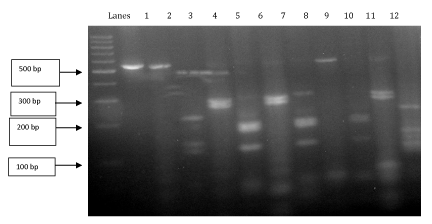
PCR for the amplification of Pre-S1/S2 region was run by using nested PCR. First round PCR was performed utilizing 230F and 800R primers (Table 1). The PCR was performed for 40 cycles involving denaturation at 94°C for 1 min, annealing at 53°C for 50 sec and extension at 72°C for 50 sec. The initial denaturation was at 94°C for 3 minutes and final extension was performed at 72°C for 10 min. Second round PCR was performed using P7 and P8 primers (Table 1) as per the method of Lindh, et al. [27]. The PCR was performed for 40 cycles involving denaturation at 94°C for 45 sec, annealing at 53°C for 1 min, extension at 72°C for 1 min 30 sec. Initial denaturation was at 94°C for 3 min and final extension was at 72°C for 7 minutes. The results were analyzed on 1.5% agarose gel with the help of UV trans-illuminator as shown in figure 1. Genotyping and subgenotyping was done using restriction enzyme Hinf1 and Tsp509I as per the protocol of Lindh, et al. [27] as shown in figure 2.

Results
Distribution of genotypes/subgenotypes
PreS1/S2 region was amplified to find out the different genotypes and subgenotypes in Punjab population (North India). Figure 1 shows amplified products of preS1/S2 region of studied samples on 1.5% agarose gel as bands of 541bp.
The banding pattern of nested PCR (using 230F and 800R primers in the first round and P7 and P8 primers in the second round, followed by restriction analysis using Hinf I and Tsp 509I for genotyping) was compared with the published results of Lindh, et al. [27]. The results of restriction analysis for the identification of genotypes/subgenotypes are shown in figure 2. The results were analyzed as per the method of Lindh, et al. [27].
Our results showed that HBV genotype D was found in 90% (19/21) of the isolates while 10% (2/21) isolates have genotype A. Subgenotype D2 (79%) was predominant among genotype D followed by subgenotype D1 (21%). Genotype A had subgenotype A1 (100%).
Discussion
The limitation of the present study is that the sample size is very small. HBV genotyping has been studied extensively around the world. The present study demonstrates that genotype D is the predominant genotype circulating in Punjab state in Northern India followed by genotype A. Genotype D has subgenotype D1 and D2. Subgenotype D2 is predominant followed by subgenotype D1 and genotype A has one subgenotype i.e. A1.
Our result is in accordance with Ababneh N, et al. [29] who observed the presence of sub-genotype D1 in Jordan populations. Our result is in accordance with Pettersson JH, et al. [30] who observed mainly the presence of genotype A and D in Norway populations. Our result is in accordance with Khan MA, et al. [31] who observed the presence of genotypes D, C, and A in Ladakh region in India, but we did not observe genotype C. Our result is in accordance with Sousa DD, et al. [32] who observed HBV subgenotypes A1, A2, D2, D3, D4, F2a, and F3 in Roraima, Brazil, but we did not observe subgenotype A2, D3, D4, F2a and F3. Our result is in accordance with Sharma B, et al. [33] who observed the presence of genotype C and genotype D from Lahaul and Spiti district in Himachal Pradesh, India, but we did not observe genotype C. Our result is in accordance with Ansari MHK, et al. [34] who observed D genotype as the main genotype of HBV in West Azarbayjan province, Northwest Iran. Our result is in accordance with Al Mahtab M, et al. [35] who observed genotype A, genotype C, and genotype D in workers of tea garden of Bangladesh, but we did not observe genotype C. Our result is in accordance with Chavan YG, et al. [36] who observed predominance of genotype D and less prevalence of Genotypes A and C among western India, but we did not observe genotype C. Our result is also in accordance with Sami H, et al. [37] who observed Genotype D as the most prevalent genotype and the surprising finding was the detection of genotype F in Aligarh region of North India. Genotype A was observed only in one case, but we did not observe genotype E and genotype F in this study.
As we know that different genotypes/subgenotypes of hepatitis B virus predicts the severity of HBV infection. The country-specific studies had found that HBV genotype C is associated with more severe liver disease than genotype B, whereas genotype D takes a more aggressive disease course than genotype A [1,38,39]. However, there are fewer studies about the clinical relevance of HBV subgenotypes. High incidence of HCC had been reported in African patients infected with subgenotype-A1, in Asian patients infected with B2-B5 and C2 and in Alaskan natives with subgenotype-F1 [21,40,41]. In contrast, A2, B1 and B6 infected individuals observed a more slow disease course [1]. Although HBV D is the most widespread of all HBV genotypes, the impacts of the various sub-genotypes of HBV D on disease progression have not been adequately explored. Of the ten D-subgenotypes, D1-D7 and D10 are non-recombinant types while D8 and D9 are D/E and D/C recombinants respectively [3,10]. Six out of the ten D-subgenotypes, namely D1-D5 and D9 had been reported from different parts of India [3,42,43].
So our study about genotypes/subgenotypes of hepatitis B virus may help to predict the severity of the disease and the appropriate therapy for HBV infected patients. So genotype/subgenotype study helps the clinician/doctor to treat the HBV infected patients accurately.
Statement of Author Contributions
RK performed laboratory work and wrote the manuscript and JS provided supervision for this research work.
Acknowledgement
Rajesh Kumar is thankful to the CSIR (Council of Scientific and Industrial Research), New Delhi (CSIR award no. F. No. 10-2(5)2003(I)-EU.II) and DST (Department of Science and Technology), New Delhi for providing financial assistance to carry out this research work.
Research Involving Human Participants and/or Animals
This research article contains studies with human participants performed by the authors.
Informed Consent
Informed consent was taken before performing that study. The institute ethics committee approved the study.
- McMahon B. The influence of hepatitis B virus genotype and subgenotype on the natural history of chronic hepatitis B. Hepatol Int. 2009; 3; 334-342. PubMed: https://www.ncbi.nlm.nih.gov/pubmed/19669359
- Datta S. An overview of molecular epidemiology of Hepatitis B Virus (HBV) in India. Virol J. 2008; 5: 156. PubMed: https://www.ncbi.nlm.nih.gov/pubmed/19099581
- Ghosh S, Banerjee P, Deny P, Mondal RK, Nandi M, Roychoudhury A, et al. New HBV subgenotype D9, a novel D/C recombinant, identified in patients with chronic HBeAg-negative infection in Eastern India. J Viral Hepat. 2013; 20: 209-218. PubMed: https://www.ncbi.nlm.nih.gov/pubmed/23383660
- Norder H, Courouce AM, Coursaget P, Echevarria JM, Lee SD, Mushahwar IK, et al. Genetic diversity of hepatitis B virus strains derived worldwide: Genotypes, subgenotypes, and HBsAg subtypes. Intervirology. 2004; 47: 289-309. PubMed: https://www.ncbi.nlm.nih.gov/pubmed/15564741
- Kramvis A, Kew M, Francois G. Hepatitis B virus genotypes. Vaccine. 2005; 23, 2409-2423. PubMed: https://www.ncbi.nlm.nih.gov/pubmed/15752827
- Yu H, Yuan Q, Ge SX, Wang HY, Zhang YL, Chen QR, et al. Molecular and phylogenetic analyses suggest an additional hepatitis B virus genotype “I”. PLoS ONE. 2010; 5: e9297. http://bit.ly/2Q37wKn
- Kramvis A. Genotypes and genetic variability of hepatitis B virus. Intervirology. 2014; 57: 141-150. PubMed: https://www.ncbi.nlm.nih.gov/pubmed/25034481
- Tatematsu K, Tanaka Y, Kurbanov F, Sugauchi F, Mano S, Maeshiro T, et al. A genetic variant of hepatitis B virus divergent from known human and ape genotypes isolated from a Japanese patient and provisionally assigned to new genotype J. J Virol. 2009; 83: 10538-10547. PubMed: https://www.ncbi.nlm.nih.gov/pubmed/19640977
- Kurbanov F, Tanaka Y, Mizokami M. Geographical and genetic diversity of the human hepatitis B virus. Hepatol Res. 2010; 40: 14-30. PubMed: https://www.ncbi.nlm.nih.gov/pubmed/20156297
- Hundie GB, Stalin Raj V, Gebre Michael D, Pas SD, Koopmans MP, Osterhaus ADME, et al. A novel hepatitis B virus subgenotype D10 circulating in Ethiopia. J Viral Hepat. 2016; 1-11. http://bit.ly/2sJblfO
- Meuleman P, Libbrecht L, Wieland S, De Vos R, Habib N, Kramvis A, et al. Immune suppression uncovers endogenous cytopathic effects of the hepatitis B virus. J Virol. 2006; 80: 2797-2807. PubMed: https://www.ncbi.nlm.nih.gov/pubmed/16501088
- Xiao SY, Lu L, Wang HL. Fibrosing cholestatic hepatitis: Clinicopathologic spectrum, diagnosis and pathogenesis. Int J Clin Exp Patho. 2008; 1: 396-402. PubMed: https://www.ncbi.nlm.nih.gov/pubmed/18787628/
- Liu WC, Phiet PH, Chiang TY, Sun KT, Hung KH, Young KC, et al. Five subgenotypes of hepatitis B virus genotype B with distinct geographic and virological distribution. Virus Res. 2007; 129: 212-223. PubMed: https://www.ncbi.nlm.nih.gov/pubmed/17825452
- Orito E, Ichida T, Sakugawa H, Sata M, Horiike N, Hino K, et al. Geographic distribution of hepatitis B virus (HBV) genotype in patients with chronic HBV infection of Japan. Hepatology. 2001; 34: 590-594. PubMed: https://www.ncbi.nlm.nih.gov/pubmed/11526547
- Alam MM, Zaidi SZ, Malik SA, Shaukat S, Naeem A, Sharif S, et al. Molecular epidemiology of hepatitis B virus genotypes in Pakistan. BMC Infect Dis. 2007; 7: 115. PubMed: https://www.ncbi.nlm.nih.gov/pubmed/17922910
- Fujiwara K, Tanaka Y, Orito E, Ohno T, Kato T, Sugihara K, et al. Distribution of HBV genotypes among HBV carriers in Benin: Phylogenetic analysis and virological characteristics of HBV genotype E. World J Gastroenterol. 2005; 11: 6410-6415. PubMed: https://www.ncbi.nlm.nih.gov/pubmed/16425408
- Kurbanov F, Tanaka Y, Fujiwara K, Sugauchi F, Mbanya D, Zekeng L, et al. A new subtype (subgenotype) Ac (A3) of hepatitis B virus and recombination between genotypes A and E in Cameroon. J Gen Virol. 2005; 86: 2047-2056. PubMed: https://www.ncbi.nlm.nih.gov/pubmed/15958684
- Zekri ARN, Hafez MM, Mohamed NI, Hassan ZK, El-Sayed MH, Khaled MM, et al. Hepatitis B Virus (HBV) genotypes in Egyptian pediatric cancer patients with acute and chronic active HBV infection. Virol J. 2007; 4: 74. http://bit.ly/36NHemi
- Singh J, Dickens C, Pahal V, Kumar R, Chaudhary R, Kramvis A, et al. First report of genotype E of hepatitis B virus in an Indian population. Intervirology. 2009; 52: 235-238. PubMed: https://www.ncbi.nlm.nih.gov/pubmed/19590227
- Arauz-Ruiz P, Norder H, Robertson BH, Magnius LO. Genotype H. a new Amerindian genotype of hepatitis B virus revealed in Central America. J Gen Virol. 2002; 83: 2059-2073. PubMed: https://www.ncbi.nlm.nih.gov/pubmed/12124470
- Livingston SE, Simonetti JP, McMahon BJ, Bulkow LR, Hurlburt KJ, Homan CE, et al. Hepatitis B virus genotypes in Alaska native people with hepatocellular carcinoma: Preponderance of Genotype F. J Infect Dis. 2007; 195: 5-11. PubMed: https://www.ncbi.nlm.nih.gov/pubmed/17152003
- Nakano T, Lu L, Hu X, Mizokami M, Orito E, Shapiro C, et al. Characterization of hepatitis B virus genotypes among yucpa Indians in venezuela. J Gen Virol. 2001; 82: 359-365. PubMed: https://www.ncbi.nlm.nih.gov/pubmed/11161274
- Chu CJ, Keeffe EB, Han SH, Perrillo RP, Min AD, Soldevila-Pico C, et al. Hepatitis B virus genotypes in the United States: Results of nationwide study. Gastroenterol. 2003; 125: 444-451. PubMed: https://www.ncbi.nlm.nih.gov/pubmed/12891547
- Stuyver L, De Gendt S, Van Geyt C, Zoulim F, Fried M, Schinazi RF, et al. A new genotype of hepatitis B virus: Complete genome and phylogenetic relatedness. J Gen Virol. 2000; 81: 67-74. PubMed: https://www.ncbi.nlm.nih.gov/pubmed/10640543
- Vieth S, Manegold C, Drosten C, Nippraschk T, Gunther S. Sequence and phylogenetic analysis of hepatitis B virus genotype G isolated in Germany. Virus Genes. 2002; 24: 153-156. http://bit.ly/34zgoNm
- Arankalle VA, Gandhe SS, Borkakoty BJ, Walimbe AM, Biswas D, Mahanta J. A novel HBV recombinant (genotype I) similar to Vietnam/Laos in a primitive tribe in eastern India. J Viral Hepat. 2010; 17: 501-510. PubMed: https://www.ncbi.nlm.nih.gov/pubmed/20059669
- Lindh M, Andersson AS, Gusdal A. Genotypes, nt 1858 variants, and geographic origin of hepatitis B virus: Large-scale analysis using a new genotyping method. J Infect Dis. 1997; 175: 1285-1293. PubMed: https://www.ncbi.nlm.nih.gov/pubmed/9180165
- Kramvis A. Genotypes and genetic variability of hepatitis B virus. Intervirology. 2014; 57: 141-150. PubMed: https://www.ncbi.nlm.nih.gov/pubmed/25034481
- Ababneh NA, Sallam M, Kaddomi D, Attili AM, Bsisu I, Khamees Nm, et al. Patterns of hepatitis B virus S gene escape mutants and reverse transcriptase mutations among genotype D isolates in Jordan. PeerJ. 2019; 7: e6583. PubMed: https://www.ncbi.nlm.nih.gov/pubmed/30867996/
- John HO Pettersson, Solveig M, Hilde E, Kirsten IEB, Kathrine SJ. Molecular epidemiology of hepatitis B virus infection in Norway. BMC Infectious Diseases. 2019; 19: 236. http://bit.ly/36OQNRO
- Khan MA, Zargar SA, Upadhyay J, Lone TA, Aggarwal R, Bashir G, et al. Epidemiology of hepatitis B and C viral infections in Ladakh region. Indian J Gastroenterol. 2018; 37: 504-510. PubMed: https://www.ncbi.nlm.nih.gov/pubmed/30543047
- Sousa DD, Silva CRS, Lima Junior WP, Barros JA, Nascimento IADS, Souza VC, et al. Phylogenetic analysis and genotype distribution of Hepatitis B Virus (HBV) in Roraima, Brazil. Rev Inst Med Trop Sao Paulo. 2018; 19: 60. http://bit.ly/36RXGBX
- Sharma B, Katiyar H, Barall D, Sharma N, Agnihotry S, Goel A. et al. Genotyping of hepatitis B virus isolates from Lahaul and Spiti district in Himachal Pradesh, India. Indian J Gastroenterol. 2018; 37: 261-265. PubMed: https://www.ncbi.nlm.nih.gov/pubmed/29855856
- Ansari MHK, Rasmi Y, Abbasi L. Hepatitis B virus genotypes in west azarbayjan province, Northwest Iran. Open Access Maced J Med Sci. 2017; 5: 875-879. PubMed: https://www.ncbi.nlm.nih.gov/pubmed/29362612
- Al Mahtab M, Akhter S, U Mollick K, H Uddin M, I Khan S, Mf Akbar S. Prevalence of hepatitis B virus and hepatitis C virus in a tea garden of Bangladesh. Euroasian J Hepatogastroenterol. 2017; 7: 107-110. PubMed: https://www.ncbi.nlm.nih.gov/pubmed/29201788
- Chavan YG, Pawar SR, Wani M, Raut AD, Misra RN. Hepatitis B virus DNA polymerase gene polymorphism based prediction of genotypes in chronic HBV patients from Western India. Afr Health Sci. 2017; 17: 762-772. PubMed: https://www.ncbi.nlm.nih.gov/pubmed/29085404
- Sami H, Rizvi M, Azam M, Mukherjee RM, Shukla I, Ajmal MR, et al. Emergence of hepatitis B virus genotype F in Aligarh region of North India. Adv Virol. 2013; 2013: 846-849. PubMed: https://www.ncbi.nlm.nih.gov/pubmed/24381592/
- Sanchez TJM, Costa J, Mas A, Bruguera M, Rodes J. Influence of hepatitis B virus genotype on the long-term outcome of chronic hepatitis B in western patients. Gastroenterology. 2002; 123: 1848-1856. PubMed: https://www.ncbi.nlm.nih.gov/pubmed/12454842
- Sumi H, Yokosuka O, Seki N, Arai M, Imazeki F, Kurihara T, et al. Influence of hepatitis B virus genotypes on the progression of chronic type b liver disease. Hepatology. 2003; 37: 19-26. PubMed: https://www.ncbi.nlm.nih.gov/pubmed/12500184
- Kew MC, Kramvis A, Yu MC, Arakawa K, Hodkinson J. Increased hepatocarcinogenic potential of hepatitis B virus genotype a in bantu-speaking sub-Saharan Africans. J Med Virol. 2005; 75: 513-521. PubMed: https://www.ncbi.nlm.nih.gov/pubmed/15714494
- Ozasa A, Tanaka Y, Orito E, Sugiyama M, Kang JH, Hige S, et al. Influence of genotypes and precore mutations on fulminant or chronic outcome of acute hepatitis B virus infection. Hepatology. 2006; 44: 326-334. PubMed: https://www.ncbi.nlm.nih.gov/pubmed/16871568
- Banerjee A, Kurbanov F, Datta S, Chandra PK, Tanaka Y, Mizokami M, et al. Phylogenetic relatedness and genetic diversity of hepatitis B virus isolates in Eastern India. J Med Virol. 2006; 78: 1164-1174. PubMed: https://www.ncbi.nlm.nih.gov/pubmed/16847957
- Banerjee P, Mondal RK, Nandi M, Ghosh S, Khatun M, Chakraborty N, et al. A rare HBV subgenotype D4 with unique genomic signatures identified in north-eastern India-an emerging clinical challenge?. PLoS ONE. 2014; 9: e109425. PubMed: https://www.ncbi.nlm.nih.gov/pubmed/25295865
Sign up for Article Alerts