A Complete Response of Metastatic Renal Cell Carcinoma to Bevacizumab and Interferon after a Nephrectomy: Case Report
Rania Chacha1*, Daniela Petran2 and Jerome Dauba3
1Department of oncology, Mohammed VI University hospital-Oujda, Morocco
2Department of oncology, Hospital of Mont de Marsan, France
3Department of oncology, Hospital of Mont de Marsan, France
*Address for Correspondence: Rania Chacha, Department of oncology, Mohammed VI University hospital-Oujda, Morocco, Tel: +336-609-538-87, ORCiD 0000-0001-8129-4968; E-mail: [email protected]
Submitted: 10 August 2018; Approved: 07 September 2018; Published: 17 September 2018
Citation this article: Chacha R, Petran D, Dauba J. A Complete Response of Metastatic Renal Cell Carcinoma to Bevacizumab and Interferon after a Nephrectomy: Case Report. Int J Cancer Cell Biol Res. 2018; 3(1): 001-004.
Copyright: © 2018 Chacha R, et al. This is an open access article distributed under the Creative Commons Attribution License, which permits unrestricted use, distribution, and reproduction in any medium, provided the original work is properly cited
Keywords: Bevacizumab; Renal cell carcinoma; Interferon alfa
Download Fulltext PDF
In general, Metastatic Renal Cell Carcinoma (mRCC) is managed with systemic treatments and cytoreductive nephrectomy is recommended only when it is feasible. Historically, systemic treatment of mRCC was limited to cytokine treatment with Interferon α (IFNα) and Interleukin (IL)-2, as chemotherapy was considered to be ineffective in these patients.
Bevacizumab in combination with interferon alfa is approved for treatment-naïve advanced Renal Cell Carcinoma (RCC) in both the US and Europe. Its objective response rates is 30%.
We report a case of a patient who presents a complete response after a nephrectomy and bevacizumab associated to interferon alpha.
Introduction
The American Cancer Society stated kidney cancer comprises approximately 3-5% of adult malignancies in the United States with approximately 61,000 new cases diagnosed and over 13,000 deaths reported in 2011 [1]. 25% to 30% of patients will present in metastatic stage and 25% to 30% are initially presented with localized disease and will progress at sometimes. Metastatic Renal Cell Cancer (RCC) has shown a resistance to chemotherapy and modest response to cytokine therapy [2]. Before the year 2000, high-dose interleukin-2 was the only drug that was approved by the U.S. Food and Drug Administration (FDA) for metastatic situation, with 10% longer duration of complete remission [3]. Interferon (IFN)-α regimens have been used to treat metastatic RCC based on a survival advantage demonstrated in some studies [4]. And histologically the most common variant of renal cancer is involving Von Hippel-Lindau (VHL) tumour suppressor gene inactivation. Normally VHL encodes a protein that is a component of a ligase for Hypoxia-Inducible Factor (HIF). Under normal oxygen tension, ligase action inactivates HIF. Under hypoxic conditions, or with VHL inactivation, HIF upregulates the transcription of multiple hypoxia-inducible genes, including those encoding Vascular Endothelial Growth Factor (VEGF), Platelet-Derived Growth Factor (PDGF), Epidermal Growth Factor Receptor (EGFR), transforming growth factor-α, and others that promote angiogenesis and cellular proliferation [3]. Other non-VHL pathways leading to RCC may share aberrant activation of the hypoxic response.
Approved therapies include inhibitors of VEGF and PDGF receptors (sunitinib and sorafenib) and mammalian Target of Rapamycin (mTOR) inhibitors (temsirolimus and everolimus) [5]. Most recently, the anti-VEGF antibody bevacizumab in combination with IFN was approved and is the subject of this case report.
Case Presentation
A 64 years old male presented with cough and chest pain, the pulmonary radiography revealed nodules and a Computed Tomography scan (CT scan) showed a voluminous renal tumour. A cytoreductive nephrectomy was performed in August 2011 and pathology revealed a Fuhrman grade 3 clear cell adenocarcinoma of 9x8x7cm with necrosis (Figure 1), and a cerebral scan revealed 2 metastases (Figure 2).
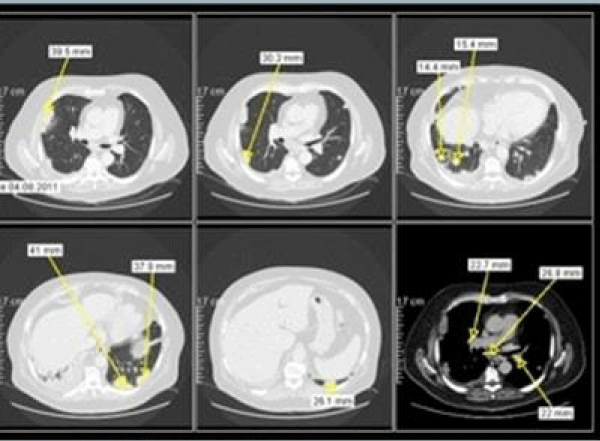
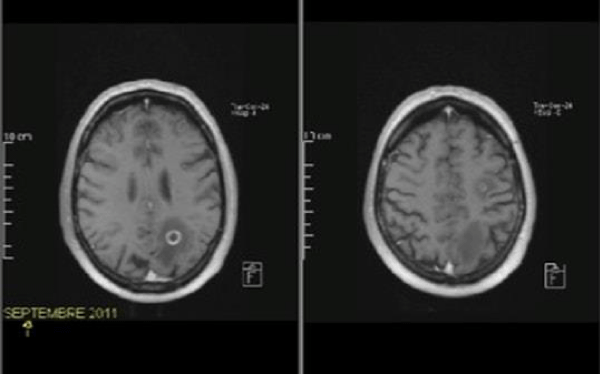
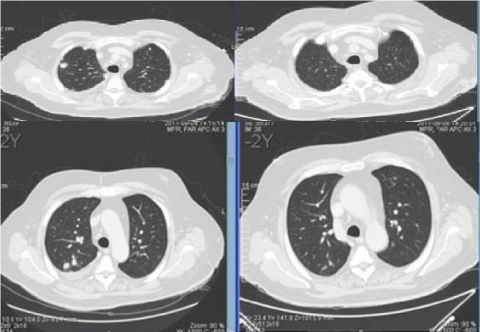
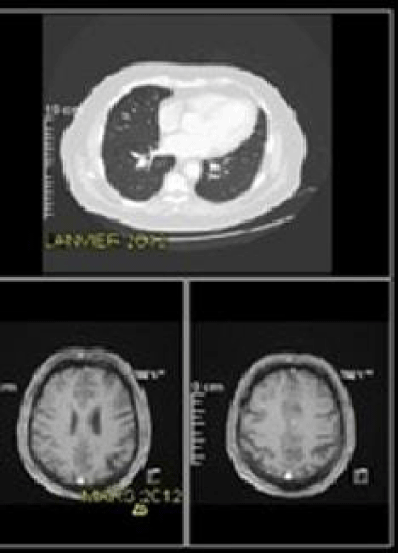
After nephrectomy a pulmonary response was observed as reduction of size of lesions (20mm vs 33.5mm) and (9mm vs 15.4mm) (Figure 3). In October 2011 a stereotaxic encephalic radiotherapy of 30Gy was realised with an interesting control of lesions (5mm vs 30mm) and (2mm vs 15mm). From November 2011 to April 2012 he received 12 cycles of Bevacizumab and interferon .A complete response mediastino-pulmonary was observed in January and cerebral complete response in March 2012, however the patient presented as side effects asthenia grade 3 because of interferon thus it was stopped and in April 2012 he presented a heart failure with ejection fraction (EF: 48%) and a pulmonary arterial hypertension (PAH: 55+10mmHg) because of bevacizumab which was stopped also and the clinical evolution was favorable with the resolution of toxicities after a cardiac control then the decision was monitoring the patient every three months. The different CT scan and Magnetic Resonance Imaging (MRI) confirmed the control of the metastatic disease (Figure 4). In June 2016 a modification of cerebral metastases was observed in favour of a late necrosis induced by the radiotherapy and that was treated with corticoids and anti-epileptic. The most recent CT scan and MRI revealed a persistence of the complete response with almost six years without any specific treatment of the cancer.
Discussion
The treatment of metastatic Renal Cell Carcinoma (mRCC) has been developed in the objective of transforming cancer to a chronic rather than a lethal disease. This has been demonstrated with the advances in systemic therapy. mRCC is known to have low response rates to classic cytotoxic therapy, with more than 70 agents had been tested and response rates is < 10% [6].
The treatment of renal cell carcinoma consists on nephrectomy if localised case and medical treatment in the metastatic case, a study showed that nephrectomy before interferon alfa-2b therapy for metastatic renal-cell cancer had a survival benefit. The place of palliative nephrectomy in monotherapy has been shown to be limited at present. Patients who present a poor condition, the surgery may lead to significant morbidity and mortality [7]. The indication for palliative surgery should be set in a symptomatic patient when the primary tumor is considered potentially unresectable and usual measures are insufficient to control the symptomatology [8]. Nephrectomy has been thought to induce spontaneous regression of metastases [7]. And metastatic sites included mainly the lungs, then the liver, the bones, the adrenal glands, the pleura, the brain, the choroid, and the pancreas.
The Quality Of Life (QoL) provided by palliative nephrectomy in selected patients may be seen improved when compared with other alternative strategies [8]. Previous trials of biologic-response modifiers in metastatic renal-cell cancer have shown an improved response rate or improved survival after surgery of the primary tumour [3]. The interval from nephrectomy to the systemic treatment of the renal-cell cancer was not controlled in these series [8]. There are also, indications of improved survival with chemotherapy after nephrectomy [9]. Several reports of immunotherapy for renal-cell cancer, with or without concomitant chemotherapy, have supported the idea that patients who undergo nephrectomy before systemic treatment have a survival advantage [10].
The immune system to improve the prognosis for metastatic RCC has led to evaluation of several immune checkpoint inhibitors and vaccination strategies in multiple ongoing trials. The OS reported with the PD-1 inhibitor Nivolumab in previously treated mRCC has already exceeded the median OS reported with IL2 in the first-line treatment of mRCC with manageable toxicities. Combinations of PD 1 inhibition with VEGF-TKIs and CTLA-4 inhibitors have shown significantly higher response rates. Meaningful clinical benefit has been observed with these checkpoint inhibitors in heavily pre-treated patients with mRCC. Immune checkpoint inhibitors under investigation include the Cytotoxic T-Lymphocyte-Associated Antigen 4 (CTLA-4) inhibitors, Ipilimumab and Tremelimumab; the programmed cell death protein 1 (PD-1) inhibitors, Nivolumab (OPDIVO which is US Food and Drug Administration [FDA], approved), Pembrolizumab, and Pidilizumab; and the Programmed Cell Death Protein Ligand 1 (PD-L1) inhibitors Atezolizumab, Durvalumab and Avelumab.
This clinical case of the complete response to the association of Bevacizumab and IFN after a nephrectomy is probably a proof of immuno-sensitivity of renal cell carcinoma.
Bevacizumab (Avastin®) is a humanised mAb that inhibits VEGF activity. It has significant clinical benefits in patients with the most common solid tumours, including metastatic colorectal carcinoma, metastatic breast cancer and non-small-cell lung carcinoma. Phase II trials demonstrated that bevacizumab has a moderate activity and is well tolerated in both groups patients therapy-naive and pre-treated mRCC [10]. Also, experience from clinical trials indicates that bevacizumab does not increase the toxicity of concomitantly administered chemotherapy [9]. And the combination of bevacizumab and interferon alfa is now approved for treatment-naïve advanced Renal Cell Carcinoma (RCC) in both the US and Europe. Its objective response rates of 30% and progression-free survival rates of 9-10 months are comparable to the other approved first-line multityrosine kinase inhibitors, sunitinib and Pazopanib [10]. The association suppress tumour growth by direct and indirect mechanisms, and these two agents may have synergistic effects when are associated. Both agents have stimulatory effects on the immune response. For example, VEGF blockade, similarly to IFN treatment, has been shown to improve the function of dendritic cells [11], which is suppressed in advanced cancer as a result of VEGF-mediated inhibition [10]. Preclinical evidence also indicates that IFN has antiangiogenic activity [12] that is both dose and schedule dependent, with lower doses having greater antiangiogenic effects than 5- to 10-fold higher doses [9].
Until the middle of this past decade, immunotherapy with Interleukin-2 (IL-2) or Interferon-α (IFN-α) was considered to be the standard of care for mRCC. Response rates with high-dose IL-2 have been reported at 20%, and complete responses at 7% achieving a durable response [13]. The toxicity profile of the association often limits its indication [14]. As most side effects we find gastrointestinal perforation (4.8%), thromboembolic events (4.0%), pulmonary embolism (3.2%), hypertension (2.7%), gastrointestinal hemorrhage (2.7%), and cerebral hemorrhage or vascular accident and for patients who receive a dose of 9-18 MIU s.c. three times per week, this regimen is associated with important toxicity, most frequently fatigue and influenza-like symptoms, also depression and asthenia [15].
The CARMENA trial, phase 3, multicenter and randomized, started in 2009. Initiated by the French Association of Urology and the Getug (Study Group of Urogenital Tumors), it was piloted at the Institute Gustave Roussy (Villejuif). A total of 450 patients were included in this trial. They were treated either by surgery then sunitinib, or by sunitinib alone. After a follow-up of approximately 4 years (51 months), overall survival was greater (> 6 months) in the group treated with Sunitib alone than in the surgery. So in practice it will be possible to offer only and faster medical treatment for patients with metastatic tumors.
For patients with cerebral metastases there is an indication of stereotaxic radiotherapy especially for small tumours < 2-3cm with a significant control. And expected patient survival may be used to guide clinicians about proper treatment strategy. Generally patients with an expected median survival < 3 months should not be exposed to potential risks of surgery or stereotactic radiotherapy since the cost/benefit ratio of these treatment modalities is questionable in this group of patients. There are other case reports published about a complete remission of metastatic RCC however other treatments have been used as sunitinib and also under gemcitabine associated to Capecitabine.
Conclusion
Metastatic renal cell carcinoma is associated with a poor prognosis but we can have a positive results if we used an intelligent strategy as the case report presented.
- Sosman J, Puzanov I. Combination targeted therapy in advanced renal cell carcinoma. Cancer. 2009; 115: 2368-2375. https://goo.gl/sVraV5
- Fisher RI, Rosenberg SA, Fyfe G. Long-term survival update for high-dose recombinant interleukin-2 in patients with renal cell carcinoma. Cancer J Sci Am. 2000; 6: 55-57. https://goo.gl/g7FipS
- McDermott DF, Regan MM, Clark JI, Flaherty LE, Weiss GR, Logan TF, et al. Randomized phase III trial of high-dose interleukin-2 versus subcutaneous interleukin-2 and interferon in patients with metastatic renal cell carcinoma. J Clin Oncol. 2005; 23: 133-141. https://goo.gl/seJtRW
- Courtney KD, Choueiri TK. Optimizing recent advances in metastatic renal cell carcinoma. Curr Oncol Rep. 2009; 11: 218-226. https://goo.gl/5JnDY1
- Sandler A, Gray R, Perry MC, Brahmer J, Schiller JH, Dowlati A, et al. Paclitaxel-carboplatin alone or with bevacizumab for non-small-cell lung cancer. N Engl J Med 2006; 355: 2542-2550. https://goo.gl/EkZx1J
- Choueiri TK, Vaziri SA, Jaeger E, Elson P, Wood L, Bhalla IP, et al. von Hippel-Lindau gene status and response to vascular endothelial growth factor targeted therapy for metastatic clear cell renal cell carcinoma. J Urol. 2008; 180: 860-865. https://goo.gl/8HV5Ma
- Molina AM, Motzer RJ. Current algorithms and prognostic factors in the treatment of metastatic renal cell carcinoma. Clin Genitourin Cancer. 2008; 6: 7-13. https://goo.gl/6JQy87
- Chowdhury S, Larkin JM, Gore ME. Recent advances in the treatment of renal cell carcinoma and the role of targeted therapies. Eur J Cancer. 2008; 44: 2152-2161. https://goo.gl/WeCLZc
- Costa LJ, Drabkin HA. Renal cell carcinoma: New developments in molecular biology and potential for targeted therapies. The oncologist. 2007; 12: 1404-1415. https://goo.gl/urH9WP
- Rini BI, Flaherty K. Clinical effect and future considerations for molecularly-targeted therapy in renal cell carcinoma. Urol Oncol. 2008; 26: 543-549. https://goo.gl/VxQMaF
- Amato RJ. Chemotherapy for renal cell carcinoma. Semin Oncol. 2000; 27: 177-186. https://goo.gl/gL84ye
- Yagoda A, Petrylak D, Thompson S. Cytotoxic chemotherapy for advanced renal cell carcinoma. Urol Clin North Am. 1993; 20: 303-321. https://goo.gl/RjpDoM
- Siegel R, Ward E, Brawley O, Jemal A. Cancer statistics 2011: the impact of eliminating socioeconomic and racial disparities on premature cancer deaths. CA Cancer J Clin. 2011; 61: 212-236. https://goo.gl/W5fCLR
- Chow WH, Devesa SS, Warren JL, Fraumeni JF. Rising incidence of renal cell cancer in the United States. JAMA. 1999; 281: 1628-1631. https://goo.gl/JMafKi
- Gupta K, Miller JD, Li JZ, Russell MW, Charbonneau C. Epidemiologic and socioeconomic burden of metastatic Renal Cell Carcinoma (mRCC): a literature review. Cancer Treat Rev. 2008; 34: 193-205. https://goo.gl/pYLm8F
Sign up for Article Alerts