Topical Cidofovir for Recalcitrant Benign Human Papillomavirus-Associated Skin Lesions?
Larry Napolitano1, Liesl Schroedl2*, Alexander Kerman2 and Christopher R. Shea3
1Piedmont Plastic Surgery and Dermatology, Shelby, NC, USA
2University of Chicago Pritzker School of Medicine, Chicago, IL, USA
3University of Chicago Medicine Department of Medicine, Section of Dermatology, Chicago, IL, USA
*Address for Correspondence: Liesl Schroedl, University of Chicago Pritzker School of Medicine, Chicago, IL, USA, Tel: +773-834-1348; Fax: + 773-702-8398; ORCID: 0000-0002-3780-8113; E-mail: E-mail: [email protected]
Submitted: 01 March 2020; Approved: 16 March 2020; Published: 18 March 2020
Citation this article: Napolitano L, Schroedl L, Kerman A, Shea CR. Risk Factors and Seroepidemiologic Analyses of Herpes Simplex Virus Types 1 and 2 in Assymptomatic Persons in a Tertiary Institution in South Eartern Nigeria. Int J Virol Infect Dis. 2020;5(1): 024-026.
Copyright: © 2020 Napolitano L, et al. This is an open access article distributed under the Creative Commons Attribution License, which permits unrestricted use, distribution, and reproduction in any medium, provided the original work is properly cited
Keywords: Topical cidofovir; Verruca vulgaris; Wart; Human papilloma virus; HPV
Download Fulltext PDF
Cidofovir is a broad-spectrum antiviral agent that has shown efficacy against skin lesions caused HPV. Due to its tolerability, topical cidofovir has gained acceptance as a treatment modality for such lesions. We present a case of verruca vulgaris refractory to imiquimod that was responsive to topical cidofovir therapy and analyze other case series in the literature of successful treatment of benign HPV-associated skin lesions with topical cidofovir. Topical cidofovir’s favorable response rate and tolerability make it a useful treatment option for patients of differing ages and immune status who have recalcitrant nonmalignant HPV-associated skin lesions.
Introduction
Cidofovir is a broad-spectrum antiviral agent that possesses activity against several DNA viruses by acting as a potent nucleoside analog of deoxycytidine monophosphate. It has been used to treat Herpes Simplex Virus (HSV), molluscum contagiosum, and Human Papillomavirus (HPV) [1]. Whereas systemic cidofovir has numerous side effects, topical cidofovir is generally well-tolerated, with the exception of two cases of acute kidney injury in association with topical cidofovir in the treatment of resistant HSV infections [2]. However, both of these cases involved potential confounding factors, including concomitant use of medications known to induce kidney injury. As a result of its overall favorable tolerability and response rate, use of topical cidofovir for HPV-associated skin lesions refractory to other treatment modalities has gained acceptance over the past few decades. Herein, we present a case of large surface area plaque verruca vulgaris recalcitrant to topical imiquimod therapy that was successfully treated with topical cidofovir, and we consider other case series in the literature employing topical cidofovir for recalcitrant benign HPV-associated skin lesions. Taken together, this case and those reported in the literature support use of topical cidofovir for refractory HPV-associated lesions for both immunocompetent and immunocompromised patients across a broad range of ages and lesion characteristics.
Case Report
A 43-year-old female of African descent presented with multiple large verruciform plaques located on bilateral palms and right foot that had been present for six months. The lesions had previously been treated with multiple modalities, including cryotherapy, surgical excision, and grafting by plastic surgery. The patient presented to dermatology seeking a second opinion for non-surgical treatment options. Her past medical history was notable for chronic back pain and atopic dermatitis, and she used clobetasol propionate 0.05% ointment twice daily for dermatitis flares.
Physical exam revealed well-demarcated, hyperkeratotic, exophytic, hypopigmented verruciform plaques located on both palms and the medial arch of right foot (Figure 1). This patient’s presentation was unusual in that the lesions were plaque-like and ranged in diameter from 3 to 9 cm, instead of the more typical nodular or papular lesions measuring millimeters in diameter. Serologic tests for HIV, HBV, and HCV were negative. Immunoglobulin profiles, CBC, and CMP were within normal limits.
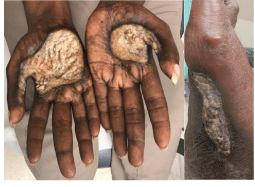
Three punch biopsy specimens were taken from lesions on each palm and from the arch of the right foot, yielding findings consistent with verruca vulgaris. Prominent papillomatosis, compact hyperkeratosis with focal hemorrhage, hypergranulosis, and acanthosis were also observed. Topical imiquimod was attempted twice daily with nightly occlusion, five days per week for four months, but the lesions remained unresponsive. During a return visit, the risks, benefits, and side effects of systemic cidofovir, topical cidofovir, intralesional bleomycin, and topical 5-fluorouracil were discussed. The patient elected to attempt topical cidofovir 3% cream, which was prescribed for use twice daily.
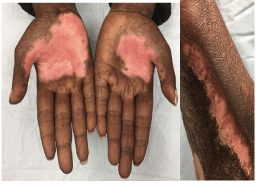
After eight weeks of treatment, the verrucous lesions had been reduced to pink granulated plaques. Cidofovir was discontinued at this point, and the patient was instructed to apply Vaseline. Fifteen weeks after initiation of treatment, the patient showed gross reepithelialization of affected areas with focal areas of repigmentation (Figure 2).
Discussion
Verruca vulgaris is an HPV-associated lesion that often persists despite a battery of treatment modalities, such as cryotherapy, surgical excision, and laser therapy. Consequently, it is crucial to seek alternative treatments in order to relieve the pain, impairment, or cosmetic distress that patients may experience due to these lesions; topical cidofovir has emerged as one of these non-first-line therapies. Review of the literature identified a number of case series of recalcitrant verruca vulgaris and other HPV-associated lesions treated with topical cidofovir. For the purposes of the review, recalcitrant was defined as failing at least one treatment modality. Cohorts were composed of immunocompetent and immunocompromised adult and pediatric patients ranging in size from 2-41 patients. In five of eight studies, a mixture of twice-daily and once-daily application was instituted; the other three of the eight studies utilized solely once-daily application. Duration of application varied from 1 to 24 weeks. Response rates, defined as percentage of patients achieving complete resolution of lesions, ranged from 32% to 100%, with a weighted response rate of approximately 57% (Table 1). The majority of outcomes were maintained over time, even in cases of periungual and plantar warts [1,3-9].
The diverse array of patients who demonstrated positive response to topical cidofovir according to the literature was notable, corroborating this as a widely applicable treatment option in patients of varying age, immune status, and lesion presentation. In conjunction with the case we presented of severe refractory verruca vulgaris responding to topical cidofovir therapy, the multitude of literature-reported successes in treating recalcitrant HPV-associated lesions with topical cidofovir substantiate use of this treatment in a broad spectrum of patients with differing lesion locations and presentations.

- Calista D. Topical cidofovir for severe cutaneous human papillomavirus and molluscum contagiosum infections in patients with HIV/AIDS. A pilot study. J Eur Acad Dermatol Venereol. 2000; 14: 484-488. PubMed: https://www.ncbi.nlm.nih.gov/pubmed/11444271
- Saunders IM, Lahoti A, Chemaly RF, Trevino C, Westmoreland M, Hosing C. Topical cidofovir-induced acute kidney injury in two severely immunocompromised patients with refractory multidrug-resistant herpes simplex virus infections. J Oncol Pharm Pract. 2016; 22: 325-331. PubMed: https://www.ncbi.nlm.nih.gov/pubmed/25488905
- Espana LP, del Boz J, Morano TF, Villafranca JA, de Troya M. Successful treatment of periungual warts with topical cidofovir. Dermatol Ther. 2014; 27: 337-342. PubMed: https://www.ncbi.nlm.nih.gov/pubmed/25081902
- Espana LP, del Boz J, Morano TF, Villafranca JA, de Troya M. Topical cidofovir for plantar warts. Dermatol Ther. 2014; 27: 89-93. PubMed: https://www.ncbi.nlm.nih.gov/pubmed/24433270
- Field S, Irvine AD, Kirby B. The treatment of viral warts with topical cidofovir 1%: Our experience of seven pediatric patients. Br J Dermatol. 2009; 160: 223-224. PubMed: https://www.ncbi.nlm.nih.gov/pubmed/19067689
- Coremans G, Margaritis V, Snoeck R, Wyndaele J, De Clercq E, Geboes K. Topical cidofovir (HPMPC) is an effective adjuvant to surgical treatment of anogenital condylomata acuminata. Dis Colon Rectum. 2003; 46: 1103-1108. PubMed: https://www.ncbi.nlm.nih.gov/pubmed/12907906
- Straigier I, Snoeck R, De Clercq E, Van den Oord JJ, Van Ranst M, De Greef H. Local treatment of HPV-induced skin lesions by cidofovir. J Med Virol. 2002; 67: 241-245. PubMed: https://www.ncbi.nlm.nih.gov/pubmed/11992585
- Zabawksi EJ, Sands B, Goetz D, Naylor M, Cockerell CJ. Treatment of verruca vulgaris with topical cidofovir. JAMA. 1997; 278: 1236. PubMed: https://www.ncbi.nlm.nih.gov/pubmed/16390407
- Fernandez‐Morano T, del Boz J, Gonzalez-Carrascosa M, Tortajada B, de Troya M. Topical cidofovir for viral warts in children. J Euro Acad Dermatol Venereol. 2011; 25: 1487-1489. PubMed: https://www.ncbi.nlm.nih.gov/pubmed/21261749
Sign up for Article Alerts